
How to Choose Curtains for a Living Room: Simple Tips That Work

You can have a sofa you love, furniture that works, and a room that is generally nice to be in and still feel like something is slightly off.
Often it is the curtains.
What's In This Post
ToggleThe wrong length, colour, or placement can make a living room feel smaller, disconnected, or unfinished. The right curtains pull the whole room together in a way that is difficult to explain until you see it happen.
You do not need to be an interior designer to get this right. You need a simple formula and a few clear rules.
The Simple Curtain Formula
Colour + Length + Fabric + Light + Style
Get these five things right and the curtains will work. Get even two of them wrong and the room will feel off regardless of everything else.
Start With the Colours Already in Your Room
Before looking at a single curtain, look at your room.
Your sofa. Your walls. Your rug. Your flooring. Your cushions. Any artwork or accent pieces.
Your curtains do not need to match everything exactly. They need to work with what is already there. The starting point is always the room, not the curtain.
Neutral curtains
White, cream, warm beige, soft taupe, and light grey are the safest and most versatile choices for a living room. They do not compete with existing colours, they let natural light feel clean and open, and they give the room a calm and timeless quality.
If you are unsure what colour to choose, a warm neutral is almost always the right decision.
Curtains with colour
Useful when the room needs more personality or when you want the curtains to be a deliberate design choice rather than a background element. A dusty sage, a warm terracotta, a soft navy. The colour should relate to something already in the room rather than arriving from nowhere.
Patterned curtains
Can work beautifully but require more care. If the room already has a patterned rug, patterned cushions, or patterned upholstery, adding patterned curtains creates visual competition. In a room with mostly solid colours, a simple pattern on the curtains can add life without overwhelming.
What Should Your Curtains Match in the Living Room?
The most common curtain mistake is trying to match the curtains to the sofa specifically. This is not necessary and can actually make the room feel less cohesive rather than more.
Instead, look for a connection between the curtains and any element already in the room.
The curtains could relate to the wall colour. To one of the cushion colours on the sofa. To a tone in the rug. To the undertone of the flooring. To the colour in a piece of artwork.
The connection does not need to be exact. It needs to exist. When the eye can find a relationship between the curtains and something else in the room, the room reads as considered rather than assembled from separate purchases.
The simplest approach is to choose a curtain colour that is either close to the wall colour or that picks up one of the secondary colours already present in the room.
Should Curtains Be Lighter or Darker Than the Couch?
Either can work. The decision depends on what the room needs.
Lighter curtains create a softer and more open feel. They tend to make the room feel airier and brighter. If the sofa is dark and the room feels heavy, lighter curtains provide contrast that lifts the space.
Darker curtains add depth and drama. They can make a room feel more intentional and sophisticated. If the room is very pale and feels flat, a slightly deeper curtain adds character.
If you are genuinely unsure, choose curtains that are close to the wall colour rather than choosing something that contrasts strongly with both the wall and the sofa. The curtain that relates to the wall colour allows the wall to read as continuous and the room to feel larger.

What Type of Curtains Are Best for a Living Room?
The best type depends on how you actually use the room.
Sheer curtains allow light through while providing a degree of privacy. They make a room feel soft and airy. Best for living rooms that receive good natural light and where privacy is not a significant concern.
Blackout or lined curtains provide privacy and light control. Useful in living rooms that face a street, catch too much afternoon sun, or where you want to reduce noise. The lining also makes curtains hang better and look more substantial.
Linen and linen-look curtains create a relaxed, natural quality. Work well in homes with a warm, earthy, or casual aesthetic. They allow some light through and hang beautifully.
Velvet curtains add richness and warmth. More dramatic and more luxurious in feel. Work well in rooms that are already styled with some depth and character.
Layered curtains combine a sheer underneath with a heavier curtain over the top. The most flexible option because you can adjust light and privacy throughout the day. Also the most polished-looking when done well.
Get the Length Right
Curtain length is where most people make the most visible mistake.
Curtains that end mid-wall below the window look like they ran out of fabric. They make the room feel lower and less finished.
Curtains that end just below the windowsill look like café curtains in a room that was not designed for café curtains.
Curtains that hang to the floor look intentional. They draw the eye to the full height of the room and make the window feel more generous than it is.
Curtains that barely graze or gently pool on the floor look the most deliberate and the most expensive.
For most living rooms, floor-length curtains are the right choice. They are not more difficult to find than shorter curtains and the difference in how the room looks is significant.
Amazon search: Floor length curtains living room, eyelet curtains neutral long, linen look curtains 90 inch.
Hang the Curtains Higher Than You Think
The curtain rod does not belong directly above the window frame.
Mounting the rod higher, closer to the ceiling, and letting the curtains fall all the way to the floor creates the impression of a taller room and a larger window. The eye follows the curtain upward and reads the ceiling as further away than it is.
The wider the rod extends beyond the window frame on each side, the more of the actual window is visible when the curtains are open. More visible window means more light and a larger-feeling window.
Mount the rod as close to the ceiling as the room allows. Extend it six to twelve inches beyond the window frame on each side. Use curtains long enough to reach the floor from that new height.
This single change makes more visual difference to a living room than almost any other curtain decision.
Curtains for a Small Living Room
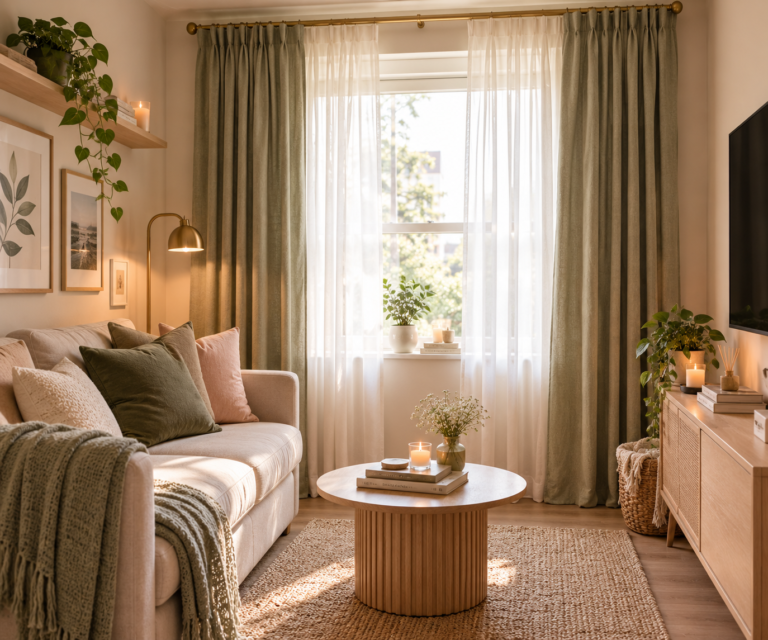
In a small living room specifically, the curtain decisions matter more because the visual impact of each element is amplified.
Choose lighter colours that reflect rather than absorb light. Simple or no pattern to reduce visual busyness. Floor-length curtains always. The rod mounted as high as possible. Curtains wide enough to frame the window fully when open rather than covering part of it.
Avoid heavy fabrics that create a visual weight the room cannot accommodate. Avoid strong contrasting colours that interrupt the continuity of the wall. The goal is curtains that make the room feel larger rather than ones that announce themselves as a separate element.
5 Curtain Mistakes That Make a Living Room Look Worse
1. Curtains that are too short. The most common and most visible mistake. Floor length or nothing.
2. The rod positioned too low. Directly above the window frame rather than near the ceiling. Loses all the visual height benefit.
3. A curtain colour that clashes with the room. Arrived without considering what is already there. The room looks assembled rather than considered.
4. Too much pattern in an already busy room. The curtains compete with everything else rather than completing the room.
5. Choosing style before considering light and privacy. Beautiful sheer curtains that provide no privacy in a ground-floor street-facing room. Practical requirements matter alongside aesthetics.
My Simple Curtain Rule
Do not choose curtains in isolation.
Look at the sofa. Look at the walls. Look at the rug. Look at how much natural light the room receives and at what time of day. Look at the height of the ceiling.
Then choose something that connects to what is already there rather than something that arrived independently of it.
The curtain that makes a living room feel finished is almost never the most dramatic or the most expensive one. It is the one that makes the rest of the room make sense.
You Do Not Need Expensive Curtains
The curtains in a living room do not need to be designer or costly to look genuinely good.
What they need is the right colour for the room, the right length for the space, the right weight for the light you want, and to be hung at the right height.
Those decisions cost nothing. They just require a few minutes of looking at what you already have before you choose what you are adding to it.
Choose curtains that make your home feel more like you.
With love,
Nia
FAQ
How do I choose curtains for my living room?
Start by looking at the existing colours in your room, your walls, sofa, rug, and cushions, and choose a curtain colour that relates to at least one of them. Decide on the light and privacy you need to determine the fabric type. Always choose floor-length curtains and hang them as high as possible.
What should curtains match in a living room?
Curtains do not need to match the sofa exactly. They should relate to at least one colour already in the room. This could be the wall colour, a tone in the rug, a cushion colour, or a colour in existing artwork. The connection does not need to be exact, just visible.
Should curtains be lighter or darker than the couch?
Either can work depending on the room. Lighter curtains create a softer, airier feel. Darker curtains add depth and drama. If unsure, choose a curtain colour close to the wall colour rather than one that contrasts strongly with both the wall and the sofa.
What type of curtains are best for a living room?
It depends on the room. Linen-look curtains for a relaxed natural feel. Lined or blackout curtains where privacy and light control matter. Sheers for an airy, light-filled room. Velvet for richness and warmth. Layered curtains for the most flexibility across different times of day.
What colour curtains make a living room look bigger?
Light, neutral curtains in a colour close to the wall, particularly white, cream, soft linen, and pale grey, reflect light and allow the eye to travel past the curtains without stopping. Combined with floor-length hanging and a high curtain rod, they create the impression of a taller and more generous room.
Should living room curtains touch the floor?
Yes. Floor-length curtains look the most intentional and the most finished. Curtains that end above the floor at any length other than deliberately designed short panels tend to look unfinished regardless of the fabric or colour.
How high should I hang living room curtains?
As close to the ceiling as the room allows. Mounting the rod near the ceiling rather than directly above the window frame makes the room feel taller, the window feel larger, and the curtains look significantly more expensive and more deliberate.