
Do Blogs Make Money in 2026? How Bloggers Actually Make Money

Quick Answer: Yes, blogs make money in 2026. But publishing articles alone is not what creates income. A blog makes money when the traffic it attracts is connected to a monetisation system. The bloggers earning consistently are not simply writing. They are building content that attracts the right readers and connecting those readers to affiliate products, services, digital products, or email lists that convert into revenue.
I know blogs make money because mine paid for my house.
What's In This Post
ToggleNot metaphorically. Not eventually after a decade. A few years after I started my first blog, the income it generated contributed to buying a home as a single mother in a corporate job who had no idea whether any of this would work when she started.
Month one: almost nothing. Month nine: my first meaningful commission. Year three: consistent income. Beyond that: a life that looks genuinely different from the one I was building before I started.
That is the honest version of the blogging income story. Not overnight. Not easy. But real and repeatable for someone who builds it correctly.
Here is exactly how it works.
Do Blogs Still Make Money in 2026?
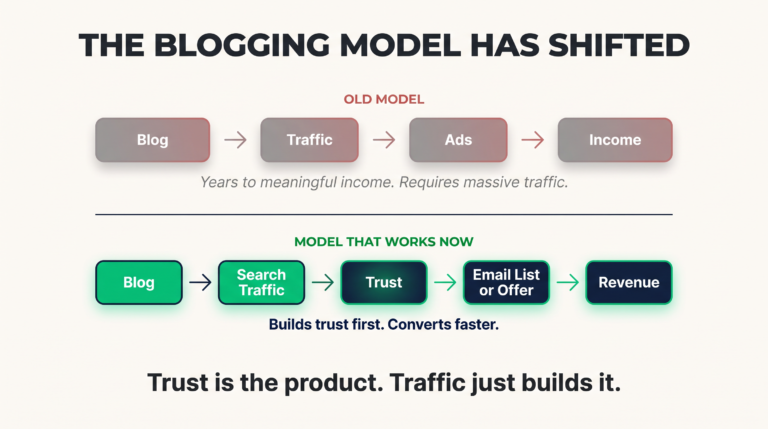
Yes. But the model has shifted.
The old approach looked like this.
Blog → Traffic → Ads → Income
That model still works at significant traffic scale. But relying purely on display advertising as a beginner takes years to produce meaningful income and requires traffic volumes that most new blogs do not reach quickly.
The model that works better and faster looks like this.
Blog → Search traffic → Trust → Email list or offer → Revenue
The difference is significant. The first model treats traffic as the product. The second model treats trust as the product and uses traffic to build it.
Blogs supporting specific products, services, email lists, and businesses are producing consistently strong income in 2026. Blogs built purely around informational content and display ads are finding the environment more competitive than it was five years ago.
Build for trust and for a clear reader-to-revenue pathway. That is the blogging model that still works.
How Do Blogs Make Money?
Here is the complete picture before we go into each method.
| Monetisation Method | Beginner Friendly | Traffic Needed | Income Potential |
|---|---|---|---|
| Affiliate marketing | High | Low to medium | High |
| Services | Very high | Low | High |
| Digital products | Medium | Medium | Very high |
| Display advertising | High | High | Medium to high |
| Sponsored content | Low | High | High |
| Email marketing | Medium | Medium | Very high |
Every method here works. The right combination depends on your niche, your traffic level, and your timeline to first income.
1. Affiliate Marketing
This is responsible for the majority of blogging income at HerDailySpace and for most serious bloggers who have built their income over time.
How it works:
Reader finds a blog post → Clicks an affiliate link → Buys the product → Blogger earns a commission
No product creation. No customer service. No inventory. Your job is to connect the right reader with the right product at the right moment through genuinely helpful content.
What makes an affiliate article convert:
The posts that earn the most affiliate commission are not the ones that lead with the product. They are the ones that lead with the problem the reader is already trying to solve.
A post titled how to start a blog with no money attracts someone in the active process of trying to start a blog. The affiliate links to hosting, email marketing platforms, and design tools inside that post arrive in a context of genuine helpfulness. The reader trusts the recommendation because the content earned that trust before making it.
How much traffic do you need:
Less than most people assume. My first commission arrived when my blog was receiving a relatively small number of monthly visitors. The post was well-optimised for a specific buyer-intent search. The right people found it. The right affiliate link was there. The commission arrived.
Traffic quality matters more than traffic volume for affiliate income. One thousand readers actively searching for a product recommendation are worth more than twenty thousand readers with no purchasing intent.
The types of posts that generate affiliate income consistently:
- How to guides with relevant tool recommendations
- Best of lists in a specific niche
- Product reviews written from genuine experience
- Comparison posts covering two or three alternatives
- Alternatives posts targeting readers looking to switch
2. Selling Services
This is the most underrated section in every make money blogging article and I want to give it the weight it deserves.
Your blog can begin generating service income before it generates affiliate income. Before SEO rankings compound. Before the email list grows. Here is why.
Content → Authority → Portfolio → Client
A blog post that demonstrates genuine expertise in a specific area is a portfolio piece. A potential client who reads it and recognises your knowledge can become a paying client without you ever having ranked for a competitive keyword.
| Blog Niche | Potential Service |
|---|---|
| Finance | Bookkeeping or financial coaching |
| Travel | Itinerary planning or travel consulting |
| Blogging | Blog setup or content strategy |
| Marketing | Social media management |
| Design | Graphic design or brand identity |
| Fitness | Online coaching |
At HerDailySpace the Crossroads Blueprint coaching programme generates income alongside affiliate marketing. The blog attracts the right women. The content builds the trust. The coaching programme converts that trust into a client relationship.
Services are not a fallback for bloggers who have not yet built significant traffic. They are a legitimate primary income stream that the blog enables rather than replaces.
3. Digital Products
Create once. Sell repeatedly. No inventory. No shipping. No customer service beyond delivery.
Digital products are the income stream with the highest long-term margin available to a blogger and the one that most rewards an audience that genuinely trusts the creator’s expertise.
What bloggers sell:
- Ebooks and guides
- Templates in Canva or Excel
- Printables and planners
- Online courses
- Checklists and workbooks
- Spreadsheets
- Preset filters and design assets
The pathway that works:
Free blog content → Trust → Email list → Digital product offer
The blog attracts the reader. The free content demonstrates the quality of what they would get in a paid product. The email list creates the ongoing relationship that eventually converts into a purchase.
The reader who buys a $37 template from a blogger they have been reading for three months converts at a completely different rate from the reader who sees a product promoted by someone they do not know.
Build the trust first. The product sale follows naturally.
4. Display Advertising
Display advertising is the most passive of all monetisation methods and the one that most requires scale to produce meaningful income.
How the economics work:
Traffic × RPM = Advertising revenue
RPM is the revenue per one thousand pageviews. On entry-level ad networks like Google AdSense the RPM is typically low. On premium networks like Mediavine or Raptive the RPM is significantly higher but the traffic threshold to qualify is also significant.
The honest reality is that a new blog with five thousand monthly pageviews will earn a very small amount from display advertising. The same blog with one hundred thousand monthly pageviews in a profitable niche can earn several thousand dollars per month from ads alone.
Display advertising is not the right first monetisation strategy for most new bloggers. It is an income layer added to a blog that is already generating traffic and already monetising through affiliate links and products.
Start with affiliate marketing and services. Add advertising when the traffic justifies it.
5. Sponsored Content
Sponsored content is a brand paying for a blog post, a social media mention, or a dedicated campaign that reaches the blog’s audience.
Sponsorships become relevant once a blog has established audience trust and consistent traffic. Brands are paying for access to a specific audience that trusts the blogger’s recommendations. Without that established trust and that consistent traffic the sponsorship value proposition is weak.
What makes a blog attractive to sponsors:
- A clearly defined audience with specific demographics
- Consistent monthly traffic
- High engagement relative to traffic
- A niche that aligns with the brand’s target customer
- Evidence of genuine audience trust
This is not a beginner income stream. It is a mid-to-established stage income addition for bloggers who have already built genuine audience relationships.
6. Email Marketing
This is the most underestimated income stream in blogging and the one that produces the most consistent revenue over time.
The pathway:
Google or Pinterest → Blog post → Free resource → Email subscriber → Product, affiliate, or service offer
Your blog attracts the visitor. One visit is not enough to build the relationship that converts into income. The email list gives you a way to continue that relationship after the visitor has closed the tab and gone on with their day.
The email subscriber who has read five emails from you converts at a significantly higher rate on an affiliate recommendation, a digital product launch, or a coaching programme than a first-time blog visitor who has read one post.
Start building an email list from day one. Not when the traffic feels sufficient. From day one. The most expensive blogging mistake is waiting to capture subscribers from traffic you already have.
How Much Money Can a Blog Make?
Rather than giving you an average blogger income figure that bears no relation to your specific situation, here is how the economics actually work across three stages.
Early stage blog:
Traffic from search and Pinterest. Monetised primarily through affiliate links and services.
Example: 3,000 monthly visitors. Two affiliate sales at $40 commission each. One small service client at $200. Monthly income approximately $280.
Growing blog:
More established traffic. Affiliate income plus digital products plus beginning email list conversions.
Example: 15,000 monthly visitors. $800 affiliate income. $400 digital product sales. $200 email list conversions. Monthly income approximately $1,400.
Established blog:
Significant search traffic. Multiple income streams operating simultaneously.
Example: 60,000 monthly visitors. $3,000 affiliate income. $1,500 digital products. $800 display advertising. $600 sponsored content. Monthly income approximately $5,900.
These are illustrative examples, not guarantees. The actual numbers depend on niche, audience intent, monetisation execution, and compounding time. The point is that income grows non-linearly. The jump from early stage to growing stage feels slow. The jump from growing to established compounds significantly faster.
How Long Does It Take for a Blog to Make Money?
| Timeline | What Is Typically Happening |
|---|---|
| Months 1 to 3 | Foundation. Publishing, keyword research, basic SEO setup. Minimal traffic. |
| Months 4 to 6 | Early rankings beginning. First trickle of search traffic. First affiliate clicks. |
| Months 7 to 12 | First meaningful monetisation. Traffic compounding. Email list building. |
| Year 1 to 2 | Consistent income. Multiple monetisation streams developing. |
| Year 2 plus | Significant compounding. Income growing with existing content. |
My personal experience maps closely to this. Month nine was when the first meaningful commission arrived. Not month one. Not month three. Month nine of consistent, strategic, patient building.
Timelines vary by niche competition, content quality, publishing frequency, distribution strategy, and monetisation method. Anyone giving you a specific guarantee is guessing. Build for the long term and treat early income as validation rather than the destination.
Can You Make Money Blogging With No Experience?
Yes. With one honest clarification.
Easy to start does not mean easy to succeed.
A blog takes twenty minutes to set up. Building one that generates consistent income takes strategy, consistency, and patience across months. The gap between those two things is where most beginner bloggers underestimate the commitment.
What beginners actually need to succeed:
- A specific audience with a specific problem
- Keywords that real people are actively searching for
- Content that genuinely serves the search intent
- A clear monetisation pathway connected to the content
- Consistent publishing over months not weeks
- The patience to let compounding begin
Experience helps but it is not the prerequisite. Strategy and consistency are.
What Type of Blog Makes the Most Money?
The answer is not simply finance or technology, though both are profitable niches.
The most accurate answer is a blog in any niche where the audience has problems worth paying to solve and where those problems connect naturally to affiliate products, digital products, or services.
High commercial intent niches:
- Personal finance and budgeting
- Software and technology tools
- Online business and marketing
- Career development
- Travel products and booking
- Beauty and skincare
- Home improvement and design
- Health and fitness
The most important nuance:
The profitable niche is not necessarily the one with the highest commission rates. It is the one where you can consistently create useful content for people who are actively trying to solve a problem and where that problem connects to products or services with an affiliate programme.
A travel blog in a specific underserved niche, solo female travel for first-time international travelers for example, can produce significant affiliate income from travel insurance, booking platforms, packing products, and travel gear even without the highest commission rates in the market.
Niche specificity and audience trust matter more than raw commission rate.
Do You Need Thousands of Visitors to Make Money?
No. And this is one of the most important things to understand early.
What different traffic levels can produce:
100 targeted visitors can potentially generate a service client if the content demonstrates genuine expertise.
1,000 targeted visitors can potentially generate consistent affiliate sales if the content matches buyer intent.
10,000 plus visitors can support diversified monetisation across affiliate, products, and advertising simultaneously.
Traffic quality determines monetisation potential more than traffic volume. One thousand readers actively searching for a hosting recommendation are more valuable than twenty thousand readers browsing casually with no purchasing intent.
This is why keyword research and search intent matter so much. You are not simply writing content. You are deliberately attracting readers who are in the mindset to act on what they find.
What I Would Do If I Started a Blog Today
Not what most blogs recommend. What I would actually do based on five years of building multiple blogs and understanding what produced income versus what produced pageviews.
- Choose a narrow specific niche rather than a broad topic I find generally interesting
- Identify commercial and buyer-intent keywords before writing a single post
- Choose one monetisation method to focus on first rather than trying everything simultaneously
- Publish 20 to 30 genuinely useful articles before expecting meaningful traffic
- Start an email list from day one with a specific free resource relevant to the niche
- Add affiliate links naturally to content already attracting the right readers
- Create one small digital product within the first six months
- Use Pinterest for additional distribution alongside Google search
- Track revenue per post not just pageviews to understand what is actually working
- Keep publishing consistently for at least twelve months before making any significant assessment of whether the strategy is working
The tenth point is the one most beginners do not follow. Month nine was when my first meaningful commission arrived. If I had assessed the blog at month seven and concluded it was not working, the house would not exist.
Blogging Compared to Other Ways to Make Money Online
| Method | Startup Cost | Speed to First Income | Long-Term Asset | Your Control |
|---|---|---|---|---|
| Freelancing | Low | Fast | Medium | High |
| Pinterest alone | Free | Medium | Medium | Medium |
| Blogging | Low | Slow | High | High |
| YouTube | Free | Medium | High | Medium |
| Affiliate marketing | Low | Medium | High | Medium |
| Digital products | Low | Medium | Very high | High |
Blogging is not the fastest way to make money online. Freelancing is faster. UGC is faster. Selling a service is faster.
Blogging is one of the strongest ways to build a content asset that earns income from posts published years ago without requiring your ongoing active time to sustain it.
That distinction matters. Choose based on your timeline and your income goal rather than on which option sounds most appealing.
The Biggest Mistakes New Bloggers Make
- Choosing too broad a niche. You cannot build topical authority across everything. Narrow down before publishing the first post.
- Writing without keyword research. Great content that nobody searches for earns nothing regardless of its quality.
- Publishing generic content. AI can now produce generic information about any topic in seconds. Content that earns in 2026 adds original experience, specific perspective, and genuine expertise.
- Waiting for ads to generate income. Display advertising requires scale. Start with affiliate marketing and services.
- Trying to monetise everything at once. One well-executed monetisation method outperforms five poorly executed ones.
- Ignoring email from the beginning. Every subscriber not captured from early traffic is a relationship that never develops.
- Focusing on pageviews instead of revenue per post. A post with five hundred visitors and three affiliate sales is more valuable than a post with five thousand visitors and zero monetisation.
- Quitting before content compounds. The majority of blogging income arrives after the first year of consistent publishing. Most bloggers quit before that.
- Building no topical authority. Twenty posts across twenty different topics builds less SEO authority than twenty posts covering one specific topic from every relevant angle.
- Having no clear reader to offer pathway. Every piece of content should have a logical next step that moves the reader closer to the monetisation system.
The Simple Blog Monetisation Funnel
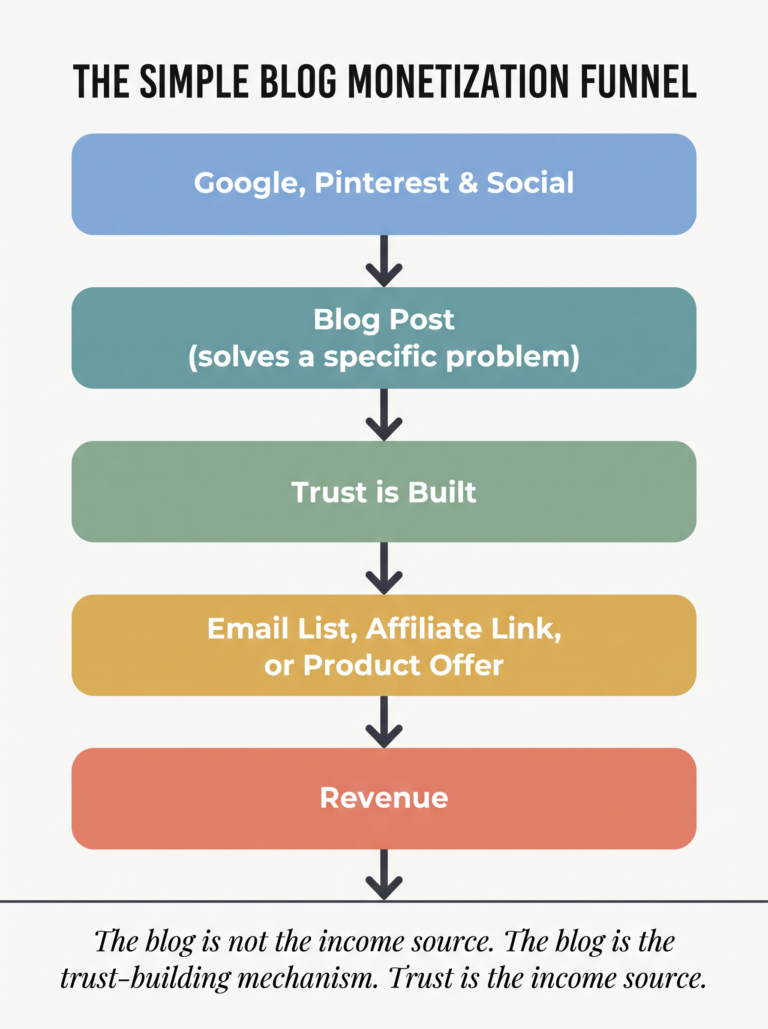
This is the model that actually works.
Google or Pinterest or Social
↓
Blog Post (solves a specific problem)
↓
Trust is built
↓
Email list, affiliate link, or product offer
↓
Revenue
The blog is not the income source. The blog is the trust-building mechanism. Trust is the income source.
Every strategic decision about what to write, which keywords to target, which affiliate products to recommend, and which digital products to create should be made in reference to this funnel rather than in isolation.
FAQ
Do blogs still make money in 2026?
Yes. Blogs connected to a clear monetisation system, affiliate marketing, services, digital products, or email, continue to produce consistent income. The purely informational blog monetised only through display advertising is finding the environment more competitive than it was several years ago. The solution is building a trust-based content asset connected to a monetisation pathway rather than relying on traffic volume alone.
Is blogging still profitable?
Blogging is still profitable for bloggers who approach it strategically. A blog in a specific niche with consistent search-optimised content, a clear audience, and a monetisation system connected to the content can produce significant income over a one to three year building period.
How much money can a beginner blogger make?
A beginner blogger in the first six to twelve months is typically building rather than earning significantly. First commissions and initial service income often arrive between months six and twelve. Meaningful consistent income typically develops in year one to two for bloggers who publish consistently and build toward a clear monetisation system.
How long does it take for a blog to make money?
Most bloggers who build strategically see first meaningful income between months seven and twelve. Consistent income that replaces or supplements a salary typically develops in year one to three depending on niche competition, content quality, and monetisation execution.
Can I make money blogging without ads?
Yes. Affiliate marketing and services can produce income from the early months of blogging without requiring the traffic scale that display advertising needs. Many profitable bloggers earn the majority of their income from affiliate commissions and digital products with advertising as a supplementary rather than primary income stream.
Can I make money blogging without affiliate marketing?
Yes. Services, digital products, sponsorships, and advertising can all generate blogging income without affiliate marketing. However, affiliate marketing is generally the most accessible starting point for bloggers in niches with relevant products because it requires no product creation and no existing audience to begin.
What is the most profitable type of blog?
The most profitable blogs are those where the audience has specific problems they are actively trying to solve and where those problems connect naturally to products or services with affiliate programmes or where the blogger’s expertise commands premium service or product pricing. Finance, software, online business, travel, beauty, and career niches all consistently produce strong affiliate and product income.
How do bloggers get paid?
Bloggers receive payments through affiliate networks via bank transfer, PayPal, or cheque depending on the programme. Service income arrives through direct invoicing or platforms like PayPal. Digital product income arrives through payment processors like Stripe or PayPal via platforms like Gumroad or WooCommerce. Display advertising networks pay monthly via bank transfer above minimum payout thresholds.
Can I start a blog with no money?
Almost. Domain registration costs approximately ten to fifteen dollars per year. Hosting costs approximately thirty to one hundred dollars per year. Everything else, the content management system, the design, the basic plugins, can be accessed for free at the entry level. The financial barrier to starting a blog is genuinely low. The investment that matters is time and consistency rather than money.
Is blogging worth it in 2026?
For someone willing to build strategically over a twelve to twenty-four month timeline, yes. Blogging produces a content asset that earns income from posts published years ago without requiring ongoing active time to sustain it. That compounding quality is unlike most other online income methods. The trade-off is the time and patience required before the compounding becomes visible.
You Do Not Need to Figure Out the Entire Journey Today
You need to know whether blogging is the right income path for your specific situation and what the first realistic step looks like from where you actually are.
Blogging made significant changes to my life. It paid for my house. It funds solo trips across the Indian Ocean. It gave me an income that does not depend on a single employer.
It is not the right starting point for everyone. It requires patience that not every timeline can accommodate. It requires consistency that not every lifestyle can sustain in the early months.
If you are trying to figure out whether blogging, affiliate marketing, or a completely different online income model makes the most sense for your specific skills, your available time, and your income goals, that is the exact decision the Crossroads Blueprint was created to help you make clearly rather than by guessing.
Explore the Crossroads Blueprint →
With love,
Nia