
Things I Want to Heal From Before I Turn 35
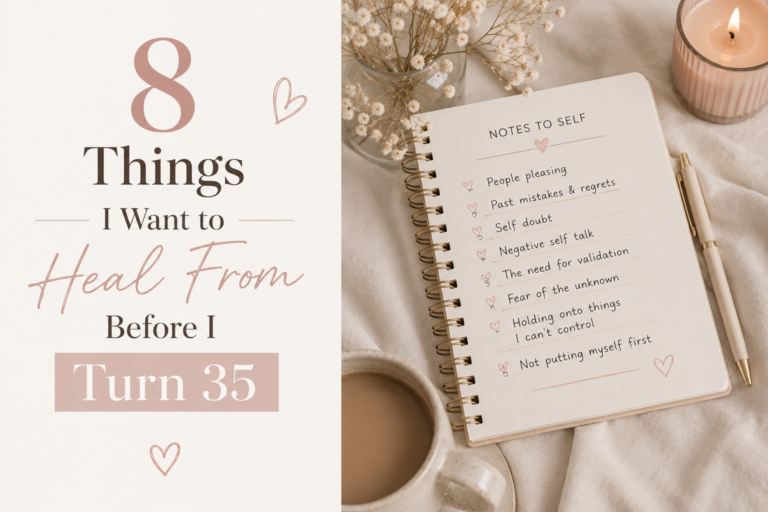
Most people create a before-milestone-birthday list of things they want to achieve.
A dream trip. A fitness goal. A financial target. A business launched. A number hit.
What's In This Post
ToggleAs my 35th birthday gets closer I find myself thinking less about what I want to accomplish and more about what I want to release. Because the older I get the more I understand that some things do not need to be achieved. They need to be healed. They need to be put down deliberately and consciously before you carry them into the next chapter of your life.
Thirty-five sits in a strange and specific place. You are no longer in the early, everything-is-still-forming part of your thirties. Forty is suddenly closer than it used to feel in a way that is impossible to ignore. And that proximity makes you ask different questions than the ones you were asking at thirty. Not just what do I want to build but what have I been carrying that was never mine to carry. Not just where do I want to go but what do I need to stop doing to actually get there.
These are the eight things I most want to heal from before I turn 35. Not because healing is a checklist you complete by a specific birthday. But because naming them is the beginning of releasing them and I am ready to begin.
Read related post: Who Is Nia? The Woman Behind HerDailySpace | Real Story
1. How to Stop People Pleasing and Start Protecting Your Peace
For most of my adult life I measured my worth by how useful I was to other people.
I said yes when I wanted to say no. Gave my time when I genuinely needed rest. Stayed silent in situations that deserved my honesty because conflict felt more dangerous than self-abandonment. I put other people’s needs so consistently ahead of my own that after a while I stopped even registering that I had needs that were worth considering.
The version of me that did this was not weak. She was trying to be loved in the way she understood love to work. She had learned somewhere, through childhood or through the relationships that followed, that her value was tied to her usefulness. That if she stopped being useful the love would stop too.
What I have learned, slowly and with some resistance, is that being kind and having boundaries are not opposites. That the people who love you well do not require unlimited access to you as proof of the love. That saying no to what depletes you is not selfishness. It is the condition for being genuinely present for the things and people that matter.
Before I turn 35 I want to stop feeling guilty for protecting my peace. Not occasionally. Consistently. As a default rather than a hard-won exception.
Read related post: The Day I Realized I Was Saving Everyone Except Myself
2. Mom Guilt: Why Good Mothers Still Feel Like They're Failing
Motherhood has given me some of the most significant moments of my life.
It has also introduced a level of guilt I did not know existed before I became a mother. The particular, persistent, impossible-to-fully-satisfy guilt of a parent who loves deeply enough to always be aware of the gap between what she is giving and what she imagines she should be giving.
There is always something more I could do. More time. More patience. More presence. More of the version of myself that is fully available and never depleted and never distracted by the other real and legitimate demands of a life I am also responsible for maintaining.
The mom guilt followed me through her early childhood and it followed me through the years when I was building the income while also raising her and it follows me now that she is sixteen and planning her own life and I am standing at the edge of this particular season understanding that it is finite in a way I cannot stop.
What I am learning, what I want to believe more fully before 35, is that my daughter does not need a perfect mother. She needs a healthy one. A mother who takes care of herself well enough to show up with something real rather than performing presence from a depleted place. A mother who models what it looks like to have needs and honour them.
The guilt does not make me a better mother. It just makes me a tired one.
Before 35 I want to stop apologising for having needs that exist outside of motherhood.
Read related post: Raising a Soft Girl in a Hard World. A Letter From a Mom Who Is Figuring It Out Too
3. Fear of Disappointing People: How to Stop Abandoning Yourself to Keep the Peace
I have spent a significant portion of my life trying to ensure that nobody felt disappointed by me.
This sounds generous. In practice it was expensive. It meant staying silent when I had something important to say. Carrying responsibilities that were never mine in the first place because someone else needed to be shielded from the consequences of their own choices. Making myself smaller, quieter, more accommodating than the situation required because the discomfort of someone else’s disappointment felt more urgent than my own.
I avoided conflict so consistently that I became someone I did not entirely recognise. The real opinions, the honest boundaries, the direct communication that healthy relationships require, those things were so regularly swallowed in the interest of keeping everyone comfortable that they started to feel dangerous even in safe situations.
What I know now is that disappointing people is not the worst thing that can happen. Abandoning yourself to prevent it is worse. The people who leave when you are honest were never staying for you. They were staying for the version of you that never said no.
Before 35 I want to become genuinely comfortable with being misunderstood by people who were not paying careful enough attention to understand me in the first place.
4. Financial Anxiety: How to Break the Cycle of Money Fear Even When You're Doing Well
My life today looks genuinely different from where it started.
I have built businesses. Created multiple income streams. Bought a house with my own name on it. Funded travel I planned and booked myself. Provided for my daughter in ways that matter. The financial evidence of the work I have done is real and visible and something I am proud of.
And financial anxiety still follows me around.
Not constantly. Not in the consuming way it did in the years when the money was genuinely scarce and the fear was proportionate to the reality. But in the quieter, more insidious way of a pattern that was formed during the hard years and has not yet fully updated to reflect the current circumstances. The slow month that triggers a fear response that belongs to a different season. The unexpected expense that immediately activates the what-if-it-all-falls-apart loop. The success that should feel settled but sits on a foundation of low-grade worry that is always quietly present.
What I am learning is that there is a real and important difference between financial responsibility and financial fear. Responsibility helps me plan, make good decisions, stay aware of my numbers and my direction. Fear steals my enjoyment of what I have built. It keeps me in the mental posture of scarcity even when the reality is abundance.
Before 35 I want to trust myself more than I trust the worst-case scenario. I want the security to come from my own proven track record rather than from the absence of anything going wrong.
Read related post: My Anxiety Doesn’t Match My Reality
5. How to Stop Feeling Responsible for Everyone and Start Letting People Carry Themselves
If someone needed help I was there.
If someone had an emergency I felt responsible for solving it. If someone was struggling financially I looked for a way to bridge the gap. If there was a problem in the lives of the people around me I oriented myself toward fixing it before I had even been asked whether I wanted to be involved.
Over time the helping became carrying. And the carrying became the kind of exhaustion that does not resolve with sleep because it is structural rather than physical. It is the exhaustion of a woman who has made herself responsible for outcomes she cannot control and people who have learned to let her.
I have written about this before. About being everyone’s emergency contact and building a safety net for the people around me while forgetting to build one for myself. About the specific dynamic of being the capable one in a family or a community and how that role, once established, becomes load-bearing in ways that are very difficult to redistribute.
What I have learned is that helping people is genuinely generous when it comes from a full place and a free choice. Trying to save everyone is impossible and the attempt depletes the one doing it without actually producing the rescue. People who are saved from their own consequences do not develop the capability to handle the next one. And the person doing the saving runs out of resources that were needed elsewhere.
Before 35 I want to stop treating other capable adults as my responsibility. I want to love them without carrying them. Those two things are allowed to be separate.
Read related post: Sibling Conflict as an Adult. How I Set Boundaries and Stopped Explaining Myself
6. Comparison to Other Women: How to Stop Measuring Your Life Against Someone Else's Timeline
Social media has made comparison available at every hour of every day and the specific comparison that gets to me is not the obvious one.
It is not the comparison of who has more. It is the comparison of timelines. The sense that other people are reaching things at a pace that reveals something unflattering about my own. The woman who seems to be further along. The life that looks more organised or more abundant or more settled from the outside. The timeline that appears to be unfolding more cleanly than mine has.
What I know intellectually and am still learning emotionally is that comparison only works when you ignore context. When you take someone else’s visible outcome and measure it against your visible outcome without accounting for the entirely different set of circumstances, starting points, support structures, and invisible costs that produced each one.
No two lives are meant to unfold on the same timeline. The detours in mine were not evidence of falling behind. They were the specific path my specific life took and that path produced something real and particular and mine in a way that a straighter route could not have.
Before 35 I want to celebrate my journey without needing to measure it against anyone else’s to know whether it counts. It counts. It has always counted. I am still learning to feel that as fully as I know it intellectually.
7. Fear of Rest: How to Stop Equating Productivity With Worth
As someone who spent years in survival mode the ability to stop and rest does not come naturally.
Stopping felt dangerous during the years when stopping meant things fell apart. Working felt like control. Productivity felt like evidence that I was going to be okay. The busyness was not just practical, it was psychological. It kept the fear quiet. As long as I was moving the anxiety about what would happen if I stopped did not have to be faced directly.
The problem is that the years passed and the survival mode became a habit and the habit became an identity and the identity became something I wore even when the emergency that created it was long over. I kept moving at survival pace through seasons that were no longer about survival. I kept working as though rest was a luxury I had not yet earned through seasons where what I actually needed was to stop and let what I had built settle into something solid beneath me.
What I know now is that rest is not the reward for sufficient productivity. It is the condition for sustainable productivity. The woman who cannot rest cannot build well for long. She builds until she collapses and then she rebuilds from zero and the cycle costs more than a deliberate practice of rest ever would have.
Before 35 I want to stop wearing busyness and burnout as evidence of my commitment to the life I am building. I want to rest because I need it. Not because I have finally run out of the ability to push through.
8. Believing You Must Struggle to Deserve Success: How to Embrace Ease Without Guilt
This is the one I am most hesitant to write about because it is the one I am least finished healing from.
Somewhere in the years of building through difficulty I absorbed a belief that struggle was the price of success. That if something came too easily it was probably not real or probably would not last or probably said something uncomfortable about the value of what I had achieved. That the only success that counted was the kind you had visibly suffered for.
This belief was forged in real experience. The things I am most proud of did require significant effort and significant cost. The house, the income, the blogs, the healing, none of that arrived without real work. And the work was worth it. I am not interested in pretending otherwise.
But the belief that hardship is the only valid path to something good has also kept me from receiving things that arrived with less resistance. Has made me suspicious of ease. Has caused me to create unnecessary difficulty in situations that did not require it because the ease felt unearned and therefore temporary.
What I am learning is that success does not need to hurt to be real. That peace does not need to be earned through preceding suffering to be deserved. That joy does not require a specific level of prior difficulty as its justification. That ease, when it arrives, is allowed to be received without immediately bracing for the moment it is taken away.
Before 35 I want to stop romanticising struggle as the only path to something worth having. I want to let good things arrive without immediately questioning whether I have suffered sufficiently to deserve them.
What Healing Before 35 Really Means
Healing before 35 does not mean arriving at this birthday having resolved every pattern and released every weight and become a finished, fully healed version of myself.
That version does not exist at 35 or at any other age. Healing is not a destination you reach and then remain at indefinitely. It is an ongoing practice of becoming aware of what you are carrying, choosing deliberately what to release, and giving yourself permission to grow beyond the version of yourself that survival mode built.
What I want before 35 is awareness. The kind that comes from naming things honestly rather than performing past them. The kind that allows me to catch the people-pleasing before it depletes me, the financial fear before it steals the joy from what I have built, the mom guilt before it convinces me that having needs makes me a bad mother.
I want to choose peace over pressure more often than I currently do. Boundaries over guilt. Rest over burnout. Self-respect over self-sacrifice. Not perfectly and not all at once. More often. With more intention.
Read related post: Turning 35: The Honest Reflection Every Woman in Her Mid-Thirties Needs to Read
My Promise to Myself Before I Turn 35
As this birthday gets closer I am not abandoning the goals and the dreams and the things I want to build.
Of course I still want more adventures. More travel to places that change something in me. More financial freedom. More moments that feel like the life I always imagined. More experiences with my daughter before she is fully launched into her own life. More of everything that the years of work were supposed to make possible.
But the most significant gift I can give myself before I turn 35 is the one that cannot be purchased or achieved or booked on a flight.
Emotional freedom.
Less guilt for existing outside of what other people need from me. Less fear about a financial future I have more than enough evidence to trust. Less pressure to be further along than I am on a timeline I invented at twenty-two without enough information. Less of the responsibility for everyone else’s outcomes that I have been carrying since before I understood I had a choice.
If I can walk into 35 carrying even a fraction less than I carried into 34 that will be one of the most meaningful accomplishments of my life. Not because the healing is visible to anyone else. But because I will feel the difference in my body and in my mornings and in the quality of my presence for the people and the work and the life that matter most.
That is what I am working toward.
That is enough.
With love,
Nia
FAQ
What are the most common things women want to heal from before turning 35?
The patterns that come up most consistently are people pleasing, mom guilt, fear of disappointing others, financial anxiety, feeling responsible for everyone around them, comparison to other women’s timelines, an inability to rest without guilt, and the belief that struggle is the only valid path to success. Most of these patterns were formed during difficult seasons and continue past the point where the difficulty that created them has resolved.
Why does turning 35 feel like such a significant milestone for healing?
Thirty-five sits at a specific inflection point. You are no longer in the earlier, more fluid part of your thirties and forty is suddenly close enough to take seriously. That proximity creates a natural invitation to reflect on what you have been carrying, what it has cost, and what you want the next chapter to feel like. Many women find 35 the first birthday that prompts this kind of honest internal audit rather than just external goal-setting.
Is it normal to feel behind emotionally at 35?
Completely. The emotional development that ideally happens in our twenties is often delayed by survival, by circumstances that required all available resources just to get through, by relationships and seasons that took more than they gave. Healing does not follow a fixed timeline and being in active emotional growth work at 35 is not late. It is honest.
Is 35 too late to heal from old patterns?
It is never too late. The most honest answer to this question is that the women who believe it is too late are the ones most likely to remain in the patterns, not because change is impossible but because the belief that it is prevents them from beginning. Starting is the whole thing. The healing follows the starting.