How I Created My First Digital Product (And What I'd Do Differently Today)
This post contains affiliate links. If you click through and make a purchase or booking, I may earn a small commission at no extra cost to you. The price you pay is exactly the same either way. I only recommend products and experiences I would use myself.
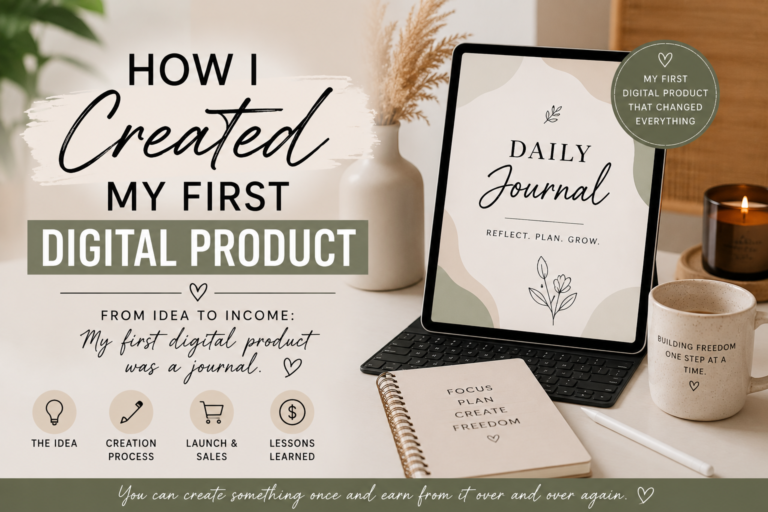
The first digital product I ever created was a journal.
What's In This Post
ToggleNot a course. Not a masterclass. Not an elaborate membership programme with multiple modules and a community platform. A journal. A beautifully designed, intentionally structured printable journal that I created in Canva, exported as a PDF, and listed for sale on my blog.
It sold.
Not in enormous numbers to begin with. But it sold to real people who found it, decided it was worth paying for, and downloaded it. And that first sale, the first time money arrived in my account from something I had created once and sold without any additional work on my part, changed something fundamental about how I understood what was possible with the business I was building.
This is the full story of how that product came to exist, what I did right, what I did embarrassingly wrong, and what I would do differently if I were creating my first digital product today.
Read related post: How To Make Money Online From Home Selling Digital Products Even as a Complete Beginner
Why I Decided to Create a Digital Product
The honest answer is that I was tired of trading time for money.
Every income stream I had built up to that point required my active ongoing time to generate income. Writing new blog posts. Managing affiliate strategy. Responding to service enquiries. All of it required me to be actively working for income to arrive. The moment I stopped working the income stopped arriving with it.
I had read enough about digital products to understand the theoretical advantage. You create something once. You sell it repeatedly. Every additional sale costs you nothing because there is no inventory, no shipping, no per-unit production cost. The margin is essentially one hundred percent after the initial creation investment. And critically, it earns while you are doing something else.
I understood the theory. What I needed was the courage to actually make something and put it out for sale.
The journal was the entry point because it was the most immediately achievable version of the concept for someone at my specific stage. I did not have enough audience yet to launch a course that people would trust me to teach. I did not have a large enough email list to generate sales from a high-ticket product. But a well-designed journal at an accessible price point was something I could create in a reasonable amount of time and sell without requiring a large existing audience to generate its first sales.
How I Chose the Journal as My First Product
The product choice was not random and I want to explain the logic because it is the logic that matters most for anyone choosing their first digital product.
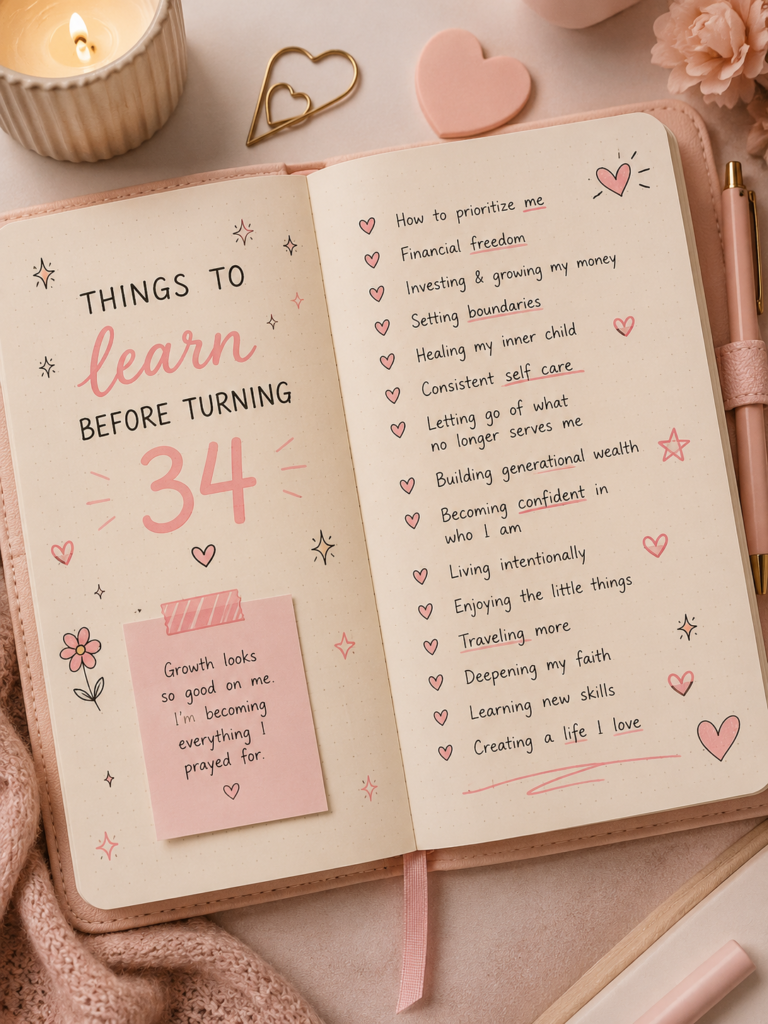
I chose a journal specifically because of where HerDailySpace sits thematically. The entire premise of this space is women who are healing and building at the same time. Women who are in the middle of becoming something, navigating the complicated space between who they were and who they are growing into.
Journaling sits directly at the intersection of those themes. It is one of the practices I write about most honestly from personal experience. It is something the HerDailySpace audience connects with specifically. And it is a product type that is consistently searched for, purchased, and genuinely used rather than one of the products people buy with good intentions and never engage with.
The questions I asked before committing to the idea were these. Does this solve a genuine problem my specific audience has. Is this something I can create with genuine quality rather than something generic. Is the price point accessible enough that the barrier to a first purchase is low. And is this something that can demonstrate enough value in the first use that people feel good about having bought it.
The journal answered yes to all four.
Read related post: My Handwriting Kept Me From Journaling for Years
The Tools I Used to Create It
The entire product was created using tools that were either free or that I was already paying for as part of my existing workflow.
Canva
Canva was the primary creation tool and the one I would still use for any printable or visual digital product today. The specific advantage of Canva for a journal is the design control it offers without requiring professional graphic design skills. I could design every page spread exactly as I wanted it, incorporate consistent branding colours and typography from HerDailySpace, and produce a final product that looked genuinely professional rather than like something made quickly in a word processor.
I used Canva’s A5 template as my starting point and built each section of the journal from there. The prompts section, the reflection pages, the monthly intention setting pages, the daily gratitude practice, the goal-setting spreads. Each element was designed deliberately to serve the woman who would be using it rather than simply filling pages with space to write.
The free version of Canva is sufficient to create a basic journal. Canva Pro, which I was already using for blog graphics and Pinterest pins, provides access to additional font choices, design elements, and the ability to resize designs efficiently across different formats.
Google Docs
I used Google Docs for two stages of the process. First for drafting all the written content, the introduction, the instructions for how to use the journal, the prompt copy for each section, before transferring it into Canva. Having the writing separate from the design meant I could focus on each element independently rather than trying to write and design simultaneously.
Second for creating the written documentation that accompanied the journal, the welcome note explaining how to use the journal and what each section was designed to do, which was included as a separate page within the final PDF.
Canva AI and ChatGPT
I used AI tools at specific stages of the process rather than throughout it, and I want to be specific about how because I think the distinction matters.
For the journal prompts specifically I used ChatGPT to generate a large initial bank of potential prompts across different themes, which I then edited, rewrote in Nia’s voice, and curated down to the specific prompts that went into the final product. The AI generated volume. I selected quality and rewrote for authenticity.
I did not use AI to write the introduction or the instructional sections because those needed to sound specifically like me and the value of the HerDailySpace brand is the genuine voice behind the content. Readers who follow this space know how Nia writes. A journal introduction that sounds like it was written by a language model rather than by the person they trust is a trust violation in a small but real way.
The use of AI was as an efficiency tool at specific stages rather than as the creator of the product. That distinction is worth maintaining for anyone creating a digital product for an audience that has chosen them specifically rather than a generic product.
WordPress and WooCommerce
I sell the journal directly from HerDailySpace using WooCommerce, which is a free WordPress plugin that adds ecommerce functionality to an existing WordPress site. The advantage of selling directly from your own site rather than through a marketplace like Etsy or Gumroad is that you keep a significantly higher percentage of the revenue and you own the customer relationship rather than the platform owning it.
The setup is more involved than listing on a marketplace but the long-term commercial advantage of direct sales justifies the initial setup investment once you are committed to building a digital product income stream.
How Long It Actually Took
I want to be honest about this because the versions that circulate online tend toward either the this took me a weekend narrative or the this took six months to perfect narrative, and the truth is somewhere between both.
The initial concept and planning stage took approximately one week. Deciding on the product type, mapping out the sections, drafting all the written content in Google Docs, and doing the research on what genuinely useful journals contain rather than simply designing something that looked nice.
The Canva design process took approximately two weeks of working in the evenings and weekend time alongside my existing content schedule. Not two full-time weeks. Two weeks of the time available in the margins of an already full working life.
The pricing, listing, and launch setup took approximately three days. Researching comparable products, deciding on the price, writing the product description, creating the Pinterest pins and promotional content, and setting up the WooCommerce listing.
Total elapsed time from concept to listed product was approximately five weeks. Total active working hours was significantly fewer than five weeks of full-time work would suggest because the creation happened alongside everything else rather than as a dedicated project.
How I Priced It
Pricing a digital product is one of the decisions that most first-time creators spend too much time on in the wrong direction, and I was no exception.
My initial instinct was to price low because I was new to selling digital products, had a relatively small audience at that stage, and was not sure the product would sell at all. Low pricing felt like reducing the risk of nobody buying.
What I eventually understood is that pricing affects perceived value as significantly as actual value. A journal priced at three dollars reads as a low-quality product regardless of what is inside it. The same journal priced at fifteen or twenty dollars reads as something worth the investment. The price signals the value before the buyer has opened the first page.
I priced the journal at a point that felt genuinely fair for the quality and the content, not at the lowest price I thought I could get away with charging, and not at an aspirational price that was disconnected from what the audience was likely to spend on a printable product at that stage of the brand’s development.
The principle I now apply to digital product pricing is this. What would I pay for this if I had not made it. What would feel like genuine value rather than a charity purchase or an overcharge. That honest self-assessment produces a better price than any formula.
How I Launched It
The launch was smaller than I imagined launches needed to be and more effective than I expected a small launch to be.
I wrote a blog post about the journal, explaining what it was, who it was for, what was inside it, and the specific problem it was designed to help with. That post is a permanent piece of content that continues to bring people to the product long after the initial launch.
I created a dedicated set of Pinterest pins for the journal specifically. Multiple pin designs pointing to the blog post about the journal rather than directly to the product page, because the blog post provides the context and the trust signal that converts a curious pinner into a buyer more effectively than a product page alone.
I mentioned it to my email list with a personal note explaining why I had created it and who I thought it was specifically for. Not a sales email in the conventional sense. An honest note from me to the people who had been reading HerDailySpace, which felt like the right tone for the product and the audience.
I shared the behind-the-scenes of creating it on the platforms where the HerDailySpace audience is active, not as promotional content but as an honest account of the process.
The initial sales were modest. They were real. And the blog post and the Pinterest pins continue to send new people to the product every month without any additional promotional work from me.
What Creating My First Digital Product Taught Me
The most important thing I learned was that done is significantly better than perfect in the context of a first digital product.
The journal I launched was good. It was not the version I would create today with more experience of what works and what does not. If I had waited until it was the version I would create today I would have missed the months of learning that happened between the first version and the current one. The imperfect launched product produces sales and learning. The perfect unlaunched product produces nothing.
I also learned that the product is only part of the income equation. A good product that nobody finds earns the same as no product at all. The blog post and the Pinterest strategy that drive people to the product are as important as the product itself. Creating the product and neglecting the distribution is a very common first-time creator mistake.
And I learned that the first product builds the muscle for the second. Creating the journal taught me everything I needed to know about the Canva workflow, the WooCommerce setup, the product description writing, the pin design for product promotion, and the general mechanics of digital product creation. The second product will take significantly less time and significantly less uncertainty because all of those systems are already in place.
Mistakes I Made with my digital product
I designed the journal before I fully confirmed what my audience specifically wanted from a journal product. I made assumptions about what would be useful based on my own journaling practice rather than asking the audience directly. The product sold, which suggests the assumptions were reasonably correct. A product validation step, asking the audience what they need before creating it, would have produced a more precisely targeted product with higher initial conversion.
I underpriced it in the very early stages before I understood the perceived value dynamic I described earlier. That initial pricing decision trained some early buyers to associate the product with a lower price point that later price adjustments had to work against.
I did not build an email capture into the product purchase flow from the beginning. Every person who purchases a digital product directly from your site is a qualified, highly engaged audience member who has already demonstrated willingness to spend money on what you create. Not capturing their email address as part of the purchase process means that relationship does not automatically continue. I added this later and it should have been there from the start.
I did not create enough Pinterest pin variations at launch. Creating multiple pin designs for the same product, each with different visual approaches and different headline angles, significantly increases the number of entry points through which people find the product on Pinterest. I started with too few and added more over time. Start with more than feels necessary.
What I Would Do Differently If I Started Again
Validate before creating. Ask the audience, through a simple poll, a question in a blog post, or an email to the list, what specific product would most useful to them before spending weeks creating something based on assumptions.
Price it correctly from the start. Research comparable products in the same niche, price at the level that reflects genuine quality rather than the lowest you think you can charge, and resist the temptation to start low as a launch tactic.
Build the email capture into the purchase flow from day one. The person who buys your first product is your most qualified future customer. Keep that relationship from the beginning.
Create at least eight to ten Pinterest pin variations at launch. Multiple visual approaches to the same product creates multiple potential entry points and the algorithm has more creative to test and distribute.
Write the blog post about the product before you list the product. The post creates the trust context that the product listing page alone cannot provide. It also starts the SEO indexing clock earlier.
Should You Create a Digital Product?
If you have an audience, even a small one, the answer is yes.
The qualification is the audience rather than the size of it. A digital product sold to the wrong audience earns nothing regardless of how good the product is. A digital product that genuinely solves a specific problem for a small but specific and trusting audience earns from the first sale.
The entry barrier is genuinely low. Canva is free to start. Google Docs is free. WooCommerce is free. The total production cost of a well-designed printable digital product is the time you invest in creating it. The income potential is uncapped and entirely passive after the creation and the initial distribution work.
If you are building a blog or any online platform and you are not yet creating digital products, you are leaving the highest-margin income stream available to you on the table. The audience you are building is an audience of people who trust your recommendations enough to read your content regularly. That trust is the foundation that converts to product sales. The product is simply the packaged version of the value you are already providing for free.
Create the first one. It will not be your best product. It will be the one that teaches you how to create the second one.
Read related post: How To Make Money Online as a Woman in 2026 A Realistic Guide for Beginners
FAQ
How do I create my first digital product with no experience?
Start with the simplest product format that genuinely solves a problem for your specific audience. Printable journals, planners, templates, checklists, and ebooks are the most accessible formats for first-time creators because they require no technical skills beyond Canva or Google Docs and no platform infrastructure beyond a basic listing page. Choose the format that most naturally fits the knowledge you already have rather than the format that sounds most impressive.
How long does it take to create a digital product?
A well-designed printable product like a journal or planner realistically takes between three and six weeks when created alongside an existing content schedule. A simple ebook or template can be created faster. A course or complex digital product takes longer. The first product always takes longer than the second because the second benefits from all the systems and learning the first one produced.
Can I create a digital product without a large following?
Yes. The first sales of a digital product come from the existing audience however small it is, from SEO traffic to the blog post about the product, and from Pinterest traffic to the same blog post. A highly targeted audience of two hundred people who trust your recommendations will generate more sales than a disengaged audience of ten thousand who do not. Audience quality and trust matter more than audience size for digital product sales specifically.
How do I market a digital product on a small audience?
Write a dedicated blog post about the product that explains what it is, who it is for, and what problem it solves. Create multiple Pinterest pin designs pointing to that post. Share it honestly with your email list. The blog post builds the trust context. Pinterest extends the reach beyond your existing audience. The email list converts the most engaged existing readers into first buyers.