
5 Best Cameras for Solo Female Travelers : Lightweight, Safe and Worth Packing
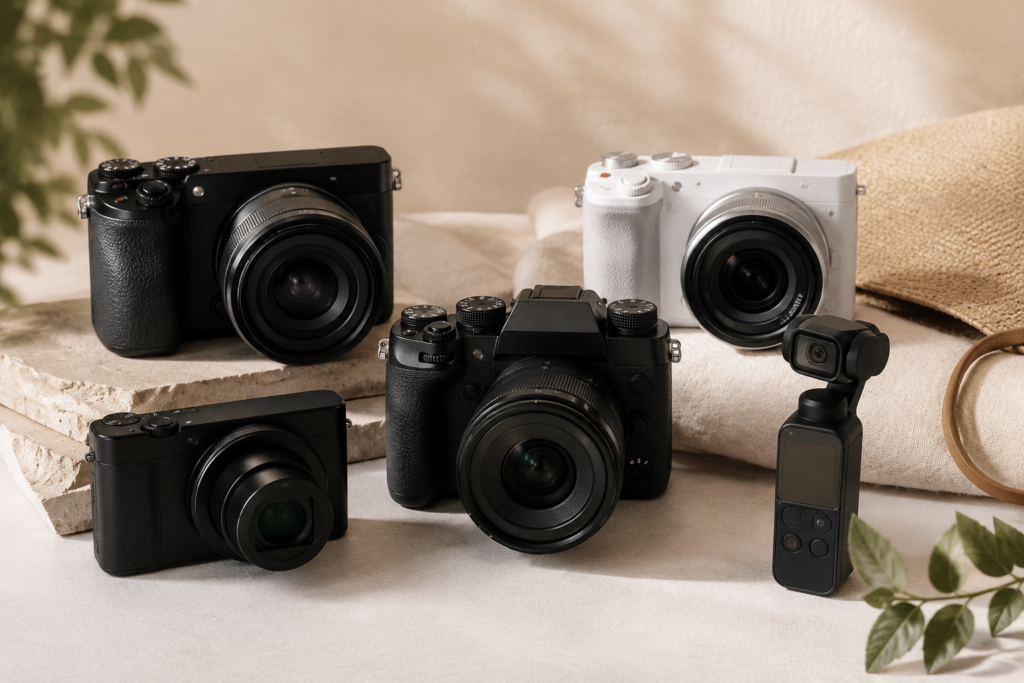
Disclaimer: The images used in this article are for illustrative purposes only and may not represent the exact product, colour, size, or current design. Please refer to the product listing for the most up-to-date images and specifications before purchasing.
This post contains affiliate links. If you click through and make a purchase or booking, I may earn a small commission at no extra cost to you. The price you pay is exactly the same either way. I only recommend products and experiences I would use myself.
What's In This Post
Toggle
Quick Answer: The best travel cameras for solo female travelers are lightweight enough to carry all day without fatigue, beginner-friendly enough to use without a manual, and produce image quality that justifies packing a dedicated camera over relying on a phone. The Sony ZV-E10 hits all three criteria better than any alternative at its price point.
Most travel camera recommendation lists are written for photographers.
They recommend the best image quality available, the most comprehensive feature set, the most versatile lens system. What they consistently underweight is the practical reality of carrying a camera alone through airports, on game drives, around unfamiliar cities, and on solo hikes where every item in the bag has to justify its weight and its safety implications.
A camera that is heavy enough to cause shoulder fatigue by midday is not a good travel camera for a solo female traveler regardless of the images it produces. A camera that is large and conspicuous enough to draw attention in a crowded market is not worth packing for security reasons alone. And a camera that requires significant technical knowledge to operate is not going to be used on the days when you are tired, rushed, or simply want to point and capture without thinking.
I evaluated cameras against the specific priorities of a solo female traveler rather than against a photographer’s brief. These five are the ones that earn their place in a travel bag.
Sony ZV-E10
The Sony ZV-E10 is the camera that offers the best combination of genuine image quality, interchangeable lens flexibility, lightweight portability, and beginner-friendly operation at a price point that most travelers can justify. It produces images and video that are genuinely better than any smartphone. It weighs under 345 grams with a lens. It fits comfortably in a crossbody bag. And the autofocus system is good enough that you do not need to understand manual settings to get consistently sharp photographs.
Shop Sony ZV-E10 Mirrorless Camera on Amazon →Quick Comparison Table
| Camera | Best For | Weight | Video | Lens Type | Price Range |
|---|---|---|---|---|---|
| Sony ZV-E10 | Best Overall | 343g | 4K | Interchangeable | $699 |
| Canon EOS R50 | Best Budget | 375g | 4K | Interchangeable | $549 |
| Fujifilm X-S20 | Best Premium | 491g | 6.2K | Interchangeable | $1299 |
| Sony RX100 VII | Best Pocket | 302g | 4K | Fixed | $1369 |
| DJI Osmo Pocket 3 | Best for Vlogging | 179g | 4K | Fixed | $448 |
The Best Cameras for Solo Female Travelers
⭐ 1. Sony ZV-E10 — Best Overall Her Daily Pick
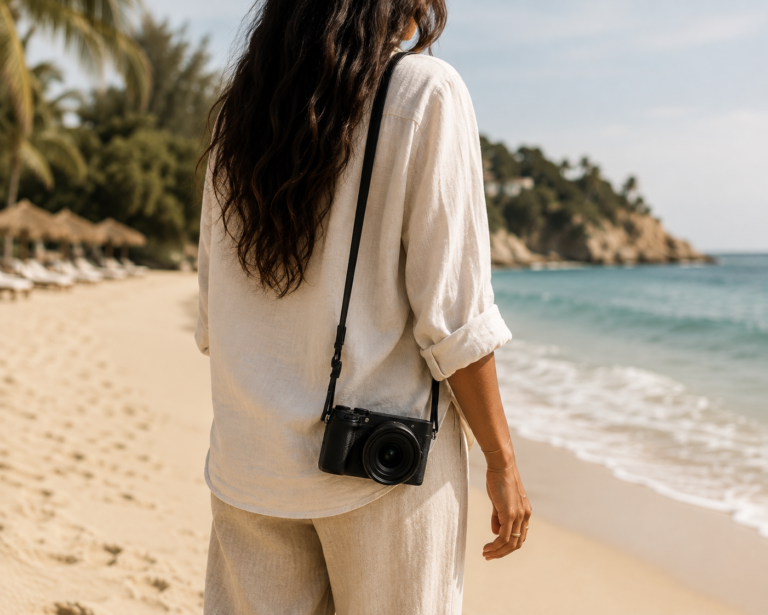
The Sony ZV-E10 was designed specifically for video content creators and vloggers which means every design decision was made with ease of use and portability in mind rather than maximum technical control. For a solo female traveler this design philosophy produces exactly the camera the travel context requires.
The autofocus system uses Sony’s Real-time Tracking which means you point the camera at something and it locks focus and holds it through movement, changing light, and composition adjustments without requiring you to do anything additional. The Product Showcase mode automatically shifts focus to anything you hold up in front of the lens, which is genuinely useful for capturing local food, flowers, market finds, and destination details without hunting for the focus manually.
The flip-out screen rotates fully forward for self-filming, which is one of the most practically important features for a solo traveler who has nobody to hold the camera. The image stabilisation works well enough for handheld travel photography. And the interchangeable lens system means you can add a wider lens for landscapes or a longer lens for wildlife without buying a new camera body.
At 343 grams with the kit lens it is genuinely light enough to carry in a crossbody bag all day without fatigue. And the APS-C sensor produces images that are meaningfully better than any current smartphone in low light, at a distance, and in the kind of high-contrast outdoor conditions that travel photography consistently produces.
Pros:
- Excellent real-time autofocus that works for beginners
- Flip-out screen for easy solo filming and photography
- Lightweight enough for all-day crossbody carrying
- Interchangeable lenses for versatility as skills develop
- 4K video at 30fps
- Genuinely beginner-friendly despite the technical capability
Cons:
- No in-body image stabilisation, relies on electronic stabilisation
- Single battery life is modest at approximately 440 shots per charge
- No weather sealing
Specifications:
- Sensor: 24.2 megapixel APS-C
- Weight: 343 grams with kit lens
- Video: 4K 30fps
- Battery life: Approximately 440 shots
- Lens mount: Sony E-mount
Best for: Solo female travelers who want genuinely better-than-phone image quality in a lightweight, beginner-friendly camera that fits in a crossbody bag and does not require technical knowledge to use well.
2. Canon EOS R50 — Best Budget Mirrorless
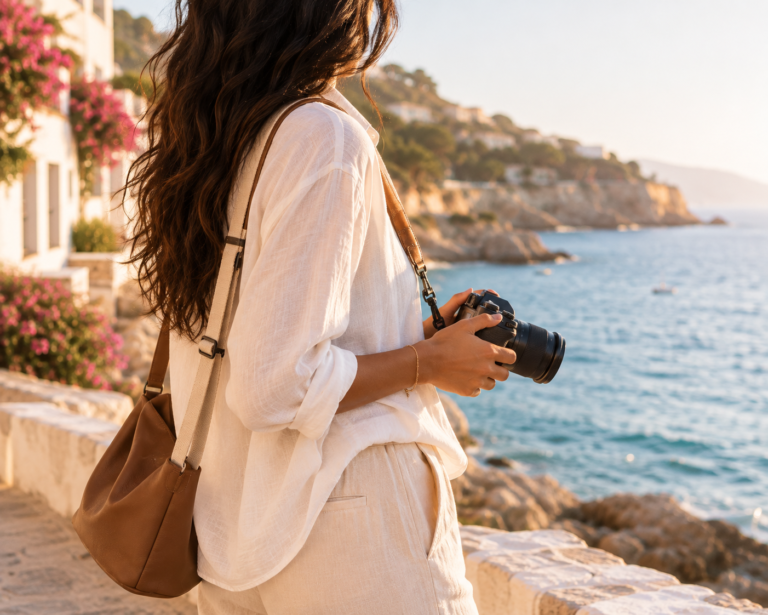
The Canon EOS R50 is the alternative to the Sony ZV-E10 for anyone who prefers the Canon ecosystem or whose photography includes a higher proportion of action and movement that benefits from Canon’s Dual Pixel autofocus system, which is among the best in class at its price point.
The R50 is slightly heavier than the ZV-E10 at 375 grams but still thoroughly manageable for all-day travel carrying. The Canon colour science produces warmer, more immediately pleasing skin tones than Sony’s default processing which some travelers prefer for portrait and lifestyle photography. The flip-out touchscreen works reliably. The 4K video performance is good. And Canon’s RF lens ecosystem, while newer than Sony’s E-mount, has excellent options available.
The limitation relative to the ZV-E10 is primarily in the specific beginner-focused features that Sony built the ZV-E10 around. The R50 is a genuinely excellent beginner mirrorless camera but it is a camera that happens to work well for beginners rather than one designed primarily for them.
Pros:
- Excellent Dual Pixel autofocus for tracking moving subjects
- Warm Canon colour science for flattering travel portraits
- Flip-out touchscreen
- 4K video performance
- Canon RF lens mount with growing ecosystem
Cons:
- 4K video crops the sensor which affects the field of view
- Slightly heavier than the Sony ZV-E10
- Less beginner-specific design than the Sony
Specifications:
- Sensor: 24.2 megapixel APS-C
- Weight: 375 grams with kit lens
- Video: 4K 30fps with crop
- Battery life: Approximately 300 shots
- Lens mount: Canon RF-S
Best for: Solo female travelers who prefer Canon’s colour science, who photograph movement frequently, or who plan to expand into a longer Canon lens system as their photography develops.
3. Fujifilm X-S20 — Best Premium
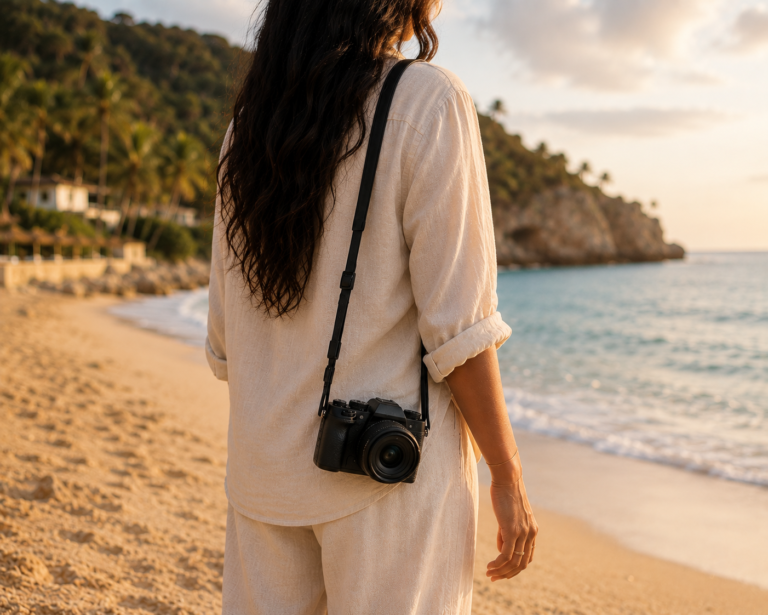
The Fujifilm X-S20 is the camera for the solo female traveler who wants the absolute best image quality available in a travel-appropriate body and is willing to carry slightly more weight and spend significantly more to access it.
The X-S20’s defining advantage is Fujifilm’s film simulation modes, which apply colour grading profiles inspired by Fujifilm’s analogue film stocks directly in-camera. The result is photographs that come out of the camera looking genuinely beautiful without post-processing, which for a traveler who wants stunning images without spending hours editing them is a meaningful practical advantage. The PROVIA, VELVIA, and Classic Chrome simulations specifically produce travel photography with a quality of warmth, depth, and character that other cameras’ colour processing does not replicate.
The X-S20 also has in-body image stabilisation, which the Sony ZV-E10 does not, making handheld shooting at slower shutter speeds more reliable. And the 6.2K video capability is the highest on this list. The trade-off is the additional weight at 491 grams and the premium price point.
Pros:
- Fujifilm film simulation modes produce exceptional in-camera colour
- In-body image stabilisation for more stable handheld shooting
- 6.2K video capability
- Excellent build quality
- Beautiful film-inspired aesthetic in the camera itself
- Large battery relative to competitors
Cons:
- The heaviest camera on this list at 491 grams
- The most expensive mirrorless option on this list
- The film simulation modes have a learning curve to find your preferences
Specifications:
- Sensor: 26.1 megapixel APS-C X-Trans
- Weight: 491 grams with kit lens
- Video: 6.2K 30fps
- Battery life: Approximately 750 shots
- Lens mount: Fujifilm X-mount
Best for: Solo female travelers who prioritise image quality and unique film-inspired colour over minimum weight, who plan to create content from their travel photography, or who want the most capable travel camera available under the professional tier.
Shop Fujifilm X-S20 Mirrorless Camera on Amazon
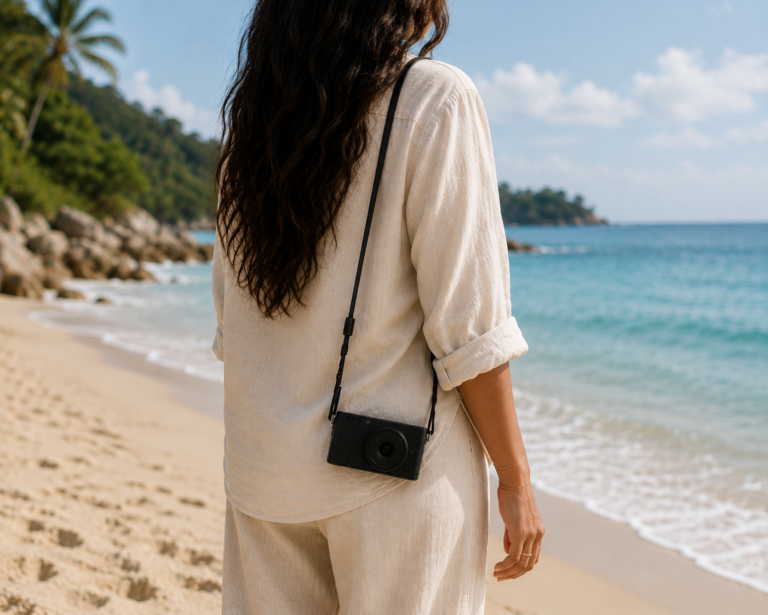
4. Sony RX100 VII — Best Pocket Camera
The Sony RX100 VII is the camera that fits in a jacket pocket and produces images that make people ask what camera you used. If the primary concern about carrying a dedicated camera is the size, the visibility, and the security implications of carrying conspicuous camera equipment, the RX100 VII eliminates those concerns while delivering image quality that surpasses every smartphone and most entry-level mirrorless cameras.
The fixed 24-200mm equivalent lens covers wide-angle to significant telephoto in a fixed lens that cannot be changed but covers the range that travel photography most commonly uses. The pop-up electronic viewfinder is the only camera on this list that includes one, which is genuinely useful in bright outdoor light where the screen is hard to see. And the autofocus system is Sony’s best real-time tracking technology in a compact body.
The significant limitation is the price. The RX100 VII is the most expensive camera on this list and it has a smaller sensor than the mirrorless options which means the low-light performance, while excellent for a compact camera, does not match the APS-C sensors of the ZV-E10, R50, or X-S20.
Pros:
- Jacket-pocket size eliminates carrying and security concerns
- 24-200mm equivalent zoom range in a fixed lens
- Pop-up electronic viewfinder for bright light shooting
- Excellent autofocus in a compact body
- Fully capable 4K video
Cons:
- Most expensive camera on this list
- Fixed lens cannot be changed for different focal lengths
- Smaller one-inch sensor has lower low-light performance than APS-C alternatives
- Very small body can feel fiddly with controls
Specifications:
- Sensor: 20.1 megapixel 1-inch
- Weight: 302 grams
- Video: 4K 30fps
- Battery life: Approximately 260 shots
- Lens: Fixed 24-200mm equivalent
Best for: Solo female travelers for whom discreet, pocketable carrying is the primary concern, travelers visiting higher-risk destinations where conspicuous camera equipment is inadvisable, and anyone who wants the best compact fixed-lens camera available.
Shop Sony RX100 VII Compact Camera on Amazon
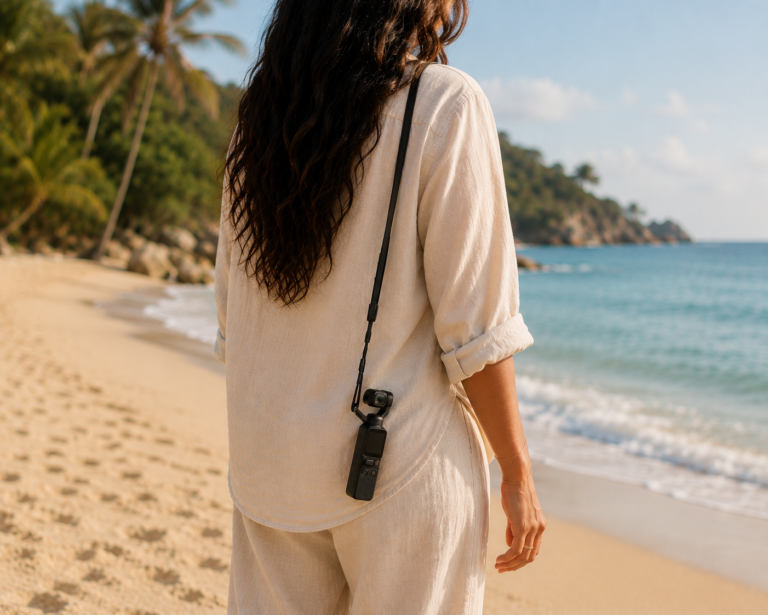
5. DJI Osmo Pocket 3 — Best for Vlogging
The DJI Osmo Pocket 3 is not a traditional camera and it earns its place on this list specifically for the solo female traveler whose primary output is video content rather than still photography.
The built-in three-axis gimbal stabilisation produces video that is genuinely stable in a way that no other camera on this list can match without an external gimbal. Walking footage, movement footage, and footage shot from a moving vehicle are all smoothed by the gimbal into something that looks professionally stabilised. The 1-inch sensor produces excellent video quality. And at 179 grams it is the lightest option on this list by a significant margin.
The limitation for still photography is real. The Osmo Pocket 3 is a video-first device and the still photography output, while functional, does not match the image quality of the mirrorless cameras. For a traveler whose primary output is social media video and vlog content, this limitation is acceptable. For a traveler who wants the best still photographs alongside good video, one of the mirrorless options is the better choice.
Pros:
- Three-axis gimbal produces outstanding video stabilisation
- The lightest camera on this list at 179 grams
- 1-inch sensor for genuinely good video quality
- Rotating screen handles solo filming naturally
- Small and discreet profile
Cons:
- Video-first design means still photography is a secondary capability
- Fixed lens with no interchangeable option
- More limited in low-light than mirrorless alternatives
Specifications:
- Sensor: 1-inch CMOS
- Weight: 179 grams
- Video: 4K 120fps
- Lens: Fixed equivalent to approximately 20mm
- Stabilisation: Three-axis mechanical gimbal
Best for: Solo female travel vloggers and content creators whose primary output is video, travelers who want the smoothest possible footage without an external gimbal, and anyone whose social media presence is video-first.
Shop DJI Osmo Pocket 3 Creator Comboa on Amazon
Why These Five Are The best Travel Cameras
Every camera on this list was evaluated against the specific criteria that matter for solo female travel rather than for photography in general.
Weight and all-day carrying comfort. A camera that causes shoulder or neck fatigue by midday will be left at the accommodation on days two and three regardless of the image quality it produces. Every camera on this list weighs under 500 grams with a lens, which keeps all-day carrying genuinely manageable.
Discreet profile for safety. Large, conspicuous camera equipment draws attention in crowded tourist environments and markets in a way that creates both security risk and an unwanted visibility for a solo female traveler. Every camera on this list is compact enough to be carried without drawing significant attention.
Beginner-friendly operation. A camera that requires understanding manual exposure settings to produce good images will be set to automatic and then the automatic will produce mediocre images and the traveler will go back to the phone. Every camera on this list produces genuinely good images in automatic or semi-automatic modes without requiring technical knowledge.
Autofocus quality for solo shooting. A solo traveler has nobody to hold the camera and frame the shot. Autofocus that works reliably for self-portraits, tripod shots, and quick captures without manual adjustment is a practical requirement rather than a nice-to-have.
Flip-out screen for self-filming. A screen that rotates to face the photographer is essential for solo travelers who want to see themselves in frame when photographing or filming alone. Every mirrorless camera on this list includes a flip-out or flip-up screen.
Value for money relative to the travel context. A camera worth thousands of dollars creates anxiety about loss, theft, and damage that detracts from the travel experience. The cameras on this list are genuinely capable without reaching the price points that make carrying them feel like a security obligation.
Mirrorless vs Compact Cameras for Travel
| Feature | Mirrorless Camera | Compact / Fixed Lens Camera |
|---|---|---|
| Image Quality | ★★★★★ Excellent | ★★★★☆ Good to Very Good |
| Lens Flexibility | Interchangeable lenses | Fixed built-in lens |
| Size | Moderate | Small to Very Small |
| Weight | Light to Moderate | Very Light |
| Video Quality | ★★★★★ Excellent | ★★★★☆ Good to Excellent |
| Beginner Friendliness | Good | Very Good |
| Best For | Versatile travel photography and content creation | Discreet, lightweight travel and everyday sightseeing |
| Price | Moderate to High | Moderate to Premium |
The mirrorless camera is the better choice for most solo female travelers because the interchangeable lens system allows the camera to grow with developing photography skills and changing travel contexts. The compact fixed-lens camera is the better choice when discreet carrying and minimum weight are the absolute priorities.
What Makes a Good Travel Camera for Solo Female Travelers?
Weight
The practical weight limit for a camera carried all day in a crossbody bag or around the neck is approximately 500 grams including the lens. Above this weight the fatigue compounds across a full day of sightseeing in a way that affects both the enjoyment of the travel and the consistency of using the camera.
Battery Life
A camera that runs out of battery mid-afternoon on a full travel day requires either carrying spare batteries or missing photographs in the critical golden hour light that most travel photography targets. Spare batteries are inexpensive and genuinely worth packing. The Fujifilm X-S20’s 750-shot battery life is the most impressive on this list and meaningful for long travel days.
Lens Options
Interchangeable lens cameras allow a single camera body to serve multiple travel contexts. The kit 16-50mm or 18-45mm lens covers most daily travel photography. Adding a 55-210mm or similar telephoto covers wildlife and distant subjects. A small prime lens like a 35mm or 50mm equivalent provides better low-light performance for evening travel photography.
Weather Resistance
Weather sealing protects the camera against rain, dust, and humidity. None of the cameras on this list except the Fujifilm X-S20 with a compatible lens has comprehensive weather sealing. For travel in environments with significant rain or dust exposure, carrying the camera in a protective bag during transit and using it carefully in wet conditions is the practical approach.
Video Quality
4K video at 30fps is the current standard for travel video that looks professional on any screen. Every camera on this list shoots 4K. The DJI Osmo Pocket 3 and Fujifilm X-S20 offer higher frame rates that allow slow-motion footage of travel moments.
Beginner Friendliness
The best travel camera for most solo female travelers is one that produces excellent results in automatic or semi-automatic modes without requiring manual exposure knowledge. Scene intelligent automatic modes, face detection autofocus, and auto ISO management all contribute to consistently good images without technical intervention.
Final Verdict On Best Camera For Travelers
Best Overall: Sony ZV-E10 for the combination of genuine image quality, beginner-friendly design, flip-out screen for solo shooting, and lightweight portability that works in a crossbody bag all day.
Best Budget Mirrorless: Canon EOS R50 for excellent autofocus, Canon’s warm colour science, and 4K video at a competitive price point.
Best Premium: Fujifilm X-S20 for the film simulation colour quality, in-body stabilisation, and the best battery life on this list.
Best Pocket Camera: Sony RX100 VII for the discreet size that eliminates carrying and security concerns while delivering genuine camera-quality images.
Best for Vlogging: DJI Osmo Pocket 3 for the three-axis gimbal stabilisation that produces smoother travel video than any other option on this list.
Still not sure which camera to choose?
If I were buying a travel camera today I would choose the Sony ZV-E10. The autofocus works without technical knowledge, the flip-out screen handles solo shooting, the image quality is genuinely above any smartphone, and the weight is light enough that it stays in the bag rather than at the accommodation. It is the camera that gets used every day of a trip rather than only on the days when you feel like being a photographer.
Shop on Amazon: Sony ZV-E10 Mirrorless Camera
With love,
Nia
FAQ
Is a mirrorless camera worth it for travel?
Yes for most travelers who want meaningfully better image quality than their phone in a portable package. The image quality advantage of a mirrorless camera over a smartphone is most apparent in low-light conditions, at a distance, and in high-contrast outdoor scenes which are exactly the conditions that travel photography most frequently produces.
What is the best travel camera under $1,500?
The Sony ZV-E10 with the kit lens typically falls under $1,500 and delivers the best combination of image quality, portability, and beginner-friendly features at that price point. The Canon EOS R50 is a strong alternative in the same price range
Can I travel with camera batteries on a plane?
Lithium ion camera batteries must be carried in carry-on luggage rather than checked luggage according to most airline regulations. Batteries up to 100 watt hours are permitted without restriction in carry-on baggage. Most camera batteries fall well under this limit. Carry spare batteries in the carry-on bag rather than packing them in checked luggage.
What camera do travel bloggers use?
Most professional travel bloggers and content creators use Sony mirrorless cameras including the Sony A7 series for professional work and the Sony ZV-E10 or ZV series for lightweight daily travel shooting. Fujifilm cameras are particularly popular among travel photographers who prioritise the aesthetic quality of in-camera colour processing. The DJI Osmo Pocket 3 is widely used specifically for vlog and social media video content.