
Amazon Affiliate Marketing for Beginners: How to Make Money in 2027

Affiliate marketing is one of the most accessible ways to earn money online and Amazon runs one of the most widely used affiliate programmes available.
The concept is straightforward. You recommend products to your audience through specially tracked links. When someone clicks your link and makes a qualifying purchase on Amazon, you earn a commission. You do not handle the product, the payment, or the delivery. You create the content and the recommendation. Amazon handles everything else.
What's In This Post
ToggleThe results, however, depend on factors that take time to build. The quality of your content. The size and relevance of your audience. How well the products you recommend match what your readers actually need. How consistently you follow Amazon’s programme rules. None of these can be shortcut, but all of them can be built deliberately.
This guide covers everything you need to understand about Amazon affiliate marketing as a beginner: how it works, how to start, where to share links, what affects your earnings, and the rules you need to know before you publish your first affiliate link.
What Is Amazon Affiliate Marketing?
How Amazon Affiliate Marketing Works
Amazon affiliate marketing works through a simple referral system.
You join Amazon’s affiliate programme. You create a special tracking link for a specific product. You include that link in your content, whether that is a blog post, a social media post, a YouTube video, or another eligible platform. A reader or viewer clicks your link and visits Amazon. If they make a qualifying purchase within the tracking window, you earn a commission on that sale.
The tracking link is what makes the system work. It tells Amazon which affiliate referred the customer. Without the tracking tag, Amazon has no way to attribute the sale to you and no commission is generated.
What Is Amazon Associates?
Amazon Associates is the name of Amazon’s official affiliate programme. It is one of the oldest and most established affiliate programmes in the world, operating across multiple Amazon marketplaces including the United States, United Kingdom, Canada, Germany, and others.
Associates is the programme you join, the dashboard you log into, the tools you use to create links, and the reports you review to track performance. You can find the programme at affiliate-program.amazon.com for the US marketplace or the equivalent page for other Amazon marketplaces.
How Amazon Affiliates Make Money
Amazon affiliates earn commissions on qualifying purchases made through their tracked links. The commission is calculated as a percentage of the qualifying revenue from eligible products in the customer’s order.
The commission rate depends on the product category rather than the individual product. Some categories earn higher rates than others. The full category commission schedule is available in your Associates account and on the programme pages. Check it directly rather than relying on rates published in articles like this one because they change over time.
It is important to understand that a click on your affiliate link does not automatically generate a commission. The customer must complete a qualifying purchase within the applicable tracking window. If they click and leave without buying, if they buy a product in a non-qualifying category, or if the purchase does not meet the programme’s qualifying criteria, no commission is earned.
How to Start Amazon Affiliate Marketing in 7 Steps
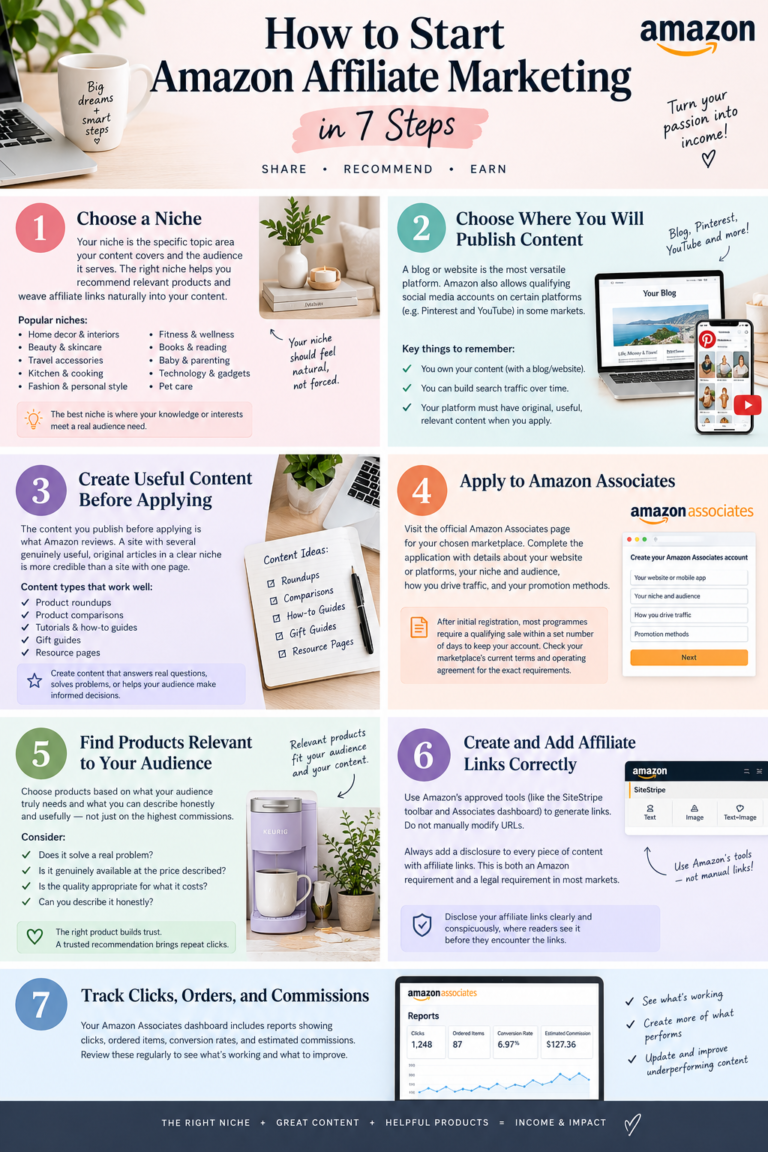
Step 1: Choose a Niche
Your niche is the specific topic area your content covers and the specific audience it serves. Your niche determines which products are naturally relevant to recommend and how authentically affiliate links can be woven into your content.
Strong niches for Amazon affiliate marketing include home decor and interiors, beauty and skincare, travel accessories and packing essentials, kitchen products and cooking, fashion and personal style, fitness and wellness, books and reading, baby and parenting, technology and gadgets, and pet care.
The most effective niche is the one that genuinely intersects your knowledge or interests with a real audience need. The content you can create consistently and well is significantly more valuable than the content targeting the highest commission category.
For HerDailySpace, the niche of life, money, and travel for women in their 30s creates natural opportunities to recommend products throughout the content. The Keurig K-Express Lavender featured in the Christmas gift guides and the shop page is a direct example of a product that fits the audience and the aesthetic without feeling like a detour from the content’s purpose.
Step 2: Choose Where You Will Publish Content
A blog or website is the most common and most versatile platform for Amazon affiliate marketing. You own the content, you can build search traffic over time, and you have complete control over how and where links are placed.
Amazon Associates also permits qualifying social media accounts on certain platforms in some markets. Pinterest, for example, is used effectively by many bloggers to drive traffic to their affiliate content. YouTube is another eligible platform in many markets.
The key is that Amazon reviews whatever website or platform you submit with your application. The platform needs to have original, useful, relevant content already published when you apply.
Step 3: Create Useful Content Before Applying
The content you publish before applying is the content Amazon reviews when assessing your application. A site with several genuinely useful, original articles in a clear niche presents a more credible application than a site with one page.
Content types that work well for Amazon affiliate marketing include product roundups listing multiple recommended items for a specific need, product comparisons evaluating two or three options against each other, tutorials and how-to guides that naturally involve products, gift guides targeting specific occasions or audiences, and resource pages listing recommended tools or essentials.
The content should be genuinely useful to your specific audience. It should answer real questions, solve real problems, or help readers make informed decisions. Content that exists primarily to host affiliate links without providing genuine value does not serve readers and does not perform well in search.
Step 4: Apply to Amazon Associates
Visit the official Amazon Associates page for the marketplace most relevant to your audience. Complete the application providing details about your website or platforms, your niche and audience, how you drive traffic, and your primary promotion methods.
After initial registration, most Amazon Associates programmes require new members to make a qualifying sale within a set number of days to maintain their account. The specific requirements vary by marketplace. Check the current programme terms and operating agreement for your specific marketplace directly.
Step 5: Find Products Relevant to Your Audience
Choose products based on what your audience genuinely needs and what you can describe honestly and usefully rather than purely on which products offer the highest commissions.
Products that are relevant to your content and genuinely useful to your readers convert at significantly higher rates than products inserted because they earn a higher commission. The reader who feels they were given a genuine, honest recommendation is the reader who trusts you enough to return and click again.
When evaluating products to recommend, consider whether the product solves a real problem for your audience, whether it is genuinely available at the price being described, whether the quality is appropriate for what it costs, and whether you can describe it honestly.
Step 6: Create and Add Affiliate Links Correctly
Amazon provides approved tools for generating affiliate links. The SiteStripe toolbar appears at the top of Amazon product pages when you are logged into your Associates account and allows you to create text links, image links, and text-plus-image links directly from the product page. Additional linking tools are available within the Associates dashboard.
Always use Amazon’s approved tools to generate links. Do not manually modify standard Amazon URLs to add tracking tags. Links that are not generated through approved methods may not track correctly and could violate the programme terms.
Add disclosures to every piece of content containing affiliate links. This is both an Amazon requirement and a legal requirement in most markets. The disclosure must be clear and conspicuous, placed where readers will see it before they encounter the links.
Step 7: Track Clicks, Orders, and Commissions
Your Amazon Associates account dashboard includes reports showing clicks, ordered items, conversion rates, and estimated commissions. Review these regularly.
The reports tell you which articles are generating clicks, which products are converting, and where the performance is strongest. This information directly informs decisions about what content to create next, which products to feature more prominently, and which articles might benefit from updating or improving.
How to Make Money With Amazon Affiliate Marketing
Write Product Roundups and Buying Guides
The product roundup is the most natural and most effective format for Amazon affiliate content. A carefully curated list of relevant products for a specific audience, occasion, or need, each described honestly and usefully, gives readers genuine help while naturally incorporating tracked links.
Examples: the best cosy home accessories under $50, essential travel accessories for carry-on travel, practical gift ideas for women in their 30s, useful kitchen tools for small apartments.
The roundup works because it matches the intent of readers who are actively researching a purchase decision. The genuinely helpful roundup builds trust as well as clicks.
Publish Product Comparisons
Comparing specific products fairly helps readers make a decision rather than simply knowing what is available. Cover the key differences in features, intended use, practical advantages, limitations, and price range. The honest comparison that acknowledges a product’s weaknesses as well as its strengths is significantly more credible than the comparison that recommends everything.
Create Tutorials That Naturally Feature Products
Tutorials that solve a real problem while naturally involving specific products provide helpful context for affiliate links and match a different search intent from the product roundup.
How to build a cosy reading corner. How to pack a carry-on for a week. How to style a neutral bedroom on a budget. How to create a morning routine that feels intentional. Each of these answers a genuine question and the products appear where they are genuinely relevant to the answer.
Build Seasonal and Gift Guide Content
Seasonal content and gift guides are among the strongest performers in Amazon affiliate marketing because the audience searching for them is often already in a purchasing mindset.
Christmas gift guides, Mother’s Day recommendations, birthday gifts by interest or age group, back-to-school essentials, and travel season packing lists all attract readers who are actively looking for product ideas. Publish seasonal content several weeks before the relevant peak period to give it time to rank in search results before the season arrives.
Use Pinterest to Send Readers to Your Blog
Pinterest is a strong discovery platform for exactly the kind of content that contains Amazon affiliate links. Product roundups, gift guides, home decor ideas, and tutorial content all perform well on Pinterest and can drive sustained traffic to blog posts for months after they are published.
Create multiple distinct pins for each article. Vary the headline, the image, and the angle rather than pinning the same design repeatedly. Use descriptive titles that accurately reflect the content the pin leads to.
Link pins to your blog posts rather than directly to Amazon product pages. The blog post provides the context, the disclosure, and the additional links that make the referral useful and compliant.
Improve Existing Content Rather Than Publishing Endlessly
One well-optimised article updated regularly often generates more income than ten thin articles published quickly and never revisited. Check existing affiliate content for outdated products, broken links, prices that are no longer accurate, and products that are no longer available. Update comparisons with currently available alternatives. Strengthen internal links between related articles. Improving existing content that already has some search traffic is often more efficient than always creating new content from scratch.
How Much Can You Earn From Amazon Affiliate Marketing?
What Affects Your Affiliate Income?
Relevant traffic: Visitors who are genuinely interested in the products being recommended. A reader searching for Christmas gift ideas for women is significantly more likely to click a product link than a general reader who arrived at a lifestyle post through social media.
Click-through rate: The percentage of readers who click your affiliate links. This is influenced by how naturally the links are integrated, how relevant the products are, and how compelling the product descriptions are.
Conversion rate: The percentage of clicks that result in qualifying purchases. Amazon’s conversion rate is generally considered strong because the buying infrastructure is familiar and trusted. However, not every click results in a purchase.
Commission category: Different product categories earn different commission rates. Check the current schedule in your Associates account.
Order value: Higher value purchases produce larger commissions at the same percentage rate.
Seasonal demand: Traffic, click-through rates, and conversion rates all typically increase around major shopping periods.
A Simple Example of Affiliate Earnings
The following is a hypothetical illustration only. It does not represent typical or guaranteed earnings.
If 1,000 readers visit an article, 50 click an affiliate link (5% click-through rate), 10 complete a qualifying purchase (20% conversion rate), and the average order earns a $2 commission, that article generates $20 in commissions from that traffic. Different traffic volumes, products, categories, and conversion rates produce entirely different results. This example illustrates the variables involved, not the income you should expect.
Why Some Affiliate Links Earn Nothing
Low-intent traffic that is not in a purchasing mindset. Products that are not relevant to the content or the reader. Weak content that does not give readers sufficient confidence to act. Broken links that do not reach the product. Purchases in non-qualifying categories. Customers who add items to their cart but do not complete the purchase within the tracking window. Each of these reduces conversion and commission earnings.
Best Platforms for Amazon Affiliate Marketing
Amazon Affiliate Marketing With a Blog
A blog or website is the strongest foundation for Amazon affiliate marketing. You own the content and the audience relationship. Search traffic can build over time and drive visitors to your content for months or years after publishing. Internal links between related articles create a content network that benefits both readers and search performance.
A blog also gives you complete control over how affiliate links are presented, how disclosures are displayed, and how the content evolves over time.
Amazon Affiliate Marketing With Pinterest
Pinterest functions as a visual search engine and is particularly well-suited to the categories that overlap strongly with Amazon affiliate content: home decor, gift ideas, fashion, beauty, travel, kitchen, and lifestyle.
Pinterest drives traffic to blog posts rather than generating commissions directly. A pin links to your blog article. The article contains the affiliate links and the disclosure. This is both the most effective and the most compliant approach to using Pinterest for Amazon affiliate marketing.
Amazon Affiliate Marketing on Social Media
Amazon permits Associates to use certain social media platforms to share affiliate content subject to the programme’s current rules and the platform’s own policies. Check the current eligibility requirements for your specific platforms before using them for affiliate promotion.
Disclosure requirements apply on social media as they do on a blog. Any post containing affiliate links must clearly disclose the affiliate relationship.
Can You Do Amazon Affiliate Marketing Without a Website?
The answer depends on which platform you intend to use and what Amazon’s current eligibility requirements are for your marketplace at the time of applying. Some social media accounts with substantial followings may qualify. A YouTube channel may qualify. The requirements change over time.
The most straightforward and sustainable approach to Amazon affiliate marketing involves a website or blog. Without it, you are dependent on the continued eligibility of a platform you do not own and the policies of both that platform and Amazon remaining aligned with your approach.
Amazon Affiliate Marketing Rules You Must Know
Disclose Affiliate Relationships Clearly
Every piece of content containing Amazon affiliate links must include a clear and conspicuous disclosure of the affiliate relationship. The disclosure must appear where readers will see it before they encounter the links, not buried at the bottom of a long article.
Amazon requires Associates to use a specific identification statement on their websites. The exact required language is in the current operating agreement. Read it directly rather than relying on a simplified version from a third-party source.
Follow Amazon’s Link and Content Policies
Amazon’s operating agreement contains specific rules about how affiliate links may be created, shared, and used. Not every promotional method is permitted. Email marketing, certain app formats, and specific types of promotional content have restrictions. Read the operating agreement for your marketplace and verify that your intended approach is permitted before implementing it.
Use Product Images and Prices Correctly
Product images, prices, reviews, and descriptions from Amazon must be obtained and displayed in ways specifically permitted by the current programme rules. You cannot simply copy images from an Amazon product listing and republish them on your site without using the approved methods. Product prices change frequently and must not be presented as permanent or guaranteed. Check the current content and image usage guidelines in the operating agreement.
Avoid Misleading Claims
Describe products honestly based on genuine research or experience. Do not fabricate reviews or endorsements. Do not make misleading income claims about what readers can expect to earn from following your advice. Honest, transparent recommendations build the kind of trust that produces repeat visitors and long-term affiliate income.
Common Amazon Affiliate Marketing Mistakes
Choosing products based on commission rate rather than audience relevance. The product your readers genuinely need converts at a higher rate than the high-commission product they do not.
Publishing thin content that provides minimal genuine value. Articles that exist primarily to host affiliate links without helping readers do not perform well in search and do not convert visitors.
Building affiliate links before building traffic. Affiliate links earn nothing without an audience. Traffic building is the foundational work that makes everything else possible.
Ignoring disclosure requirements. This is both an Amazon programme requirement and a legal requirement in most markets. It is non-negotiable.
Publishing inaccurate product details or leaving broken links unchecked. Products go out of stock. Prices change. Links break. Regular content maintenance is a practical necessity for affiliate content to remain effective.
Expecting immediate income. Building an audience and building search traffic takes time. Affiliate income follows audience growth. It is a long-term result of consistent effort rather than an immediate return.
Failing to track and use performance data. Your Associates dashboard tells you what is working. Use it to make informed decisions about what to create and improve next.
Your First 30 Days of Amazon Affiliate Marketing
Week 1: Choose Your Niche and Research Reader Needs
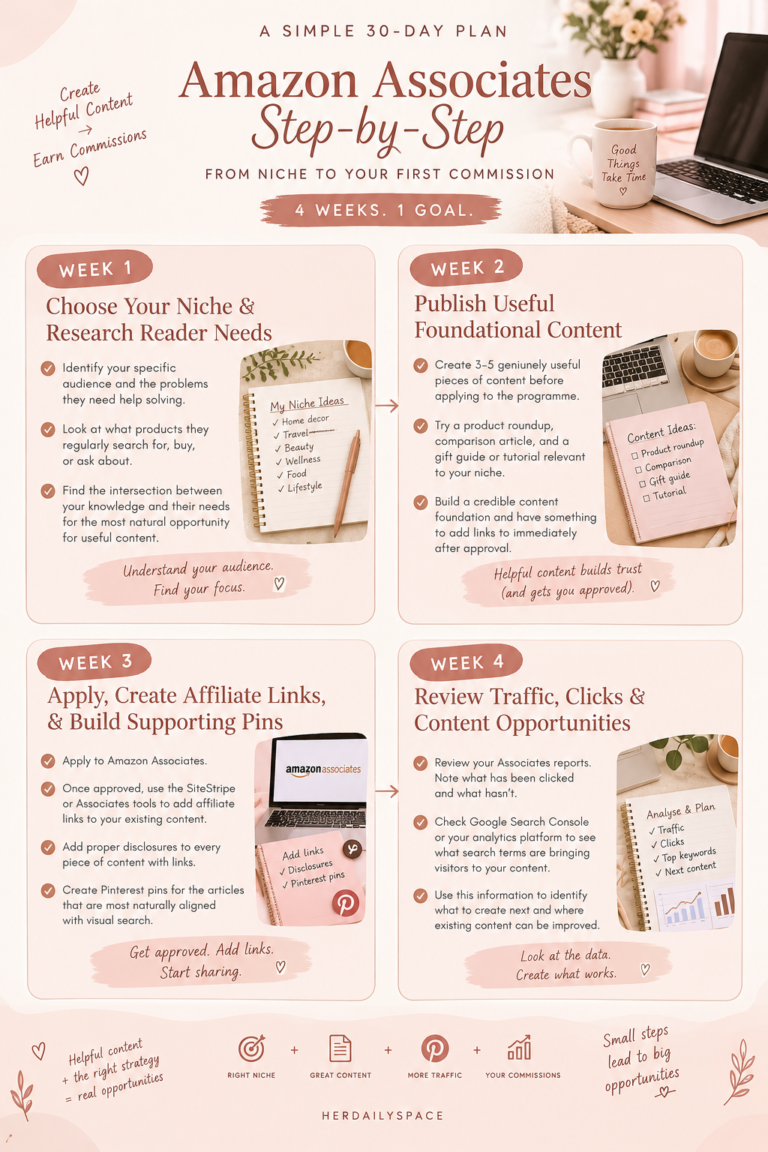
Identify your specific audience and the problems they need help solving. What products do they regularly search for, buy, or ask about. Where does the intersection between your knowledge and their needs create the most natural opportunity for useful content.
Week 2: Publish Useful Foundational Content
Create three to five genuinely useful pieces of content before applying to the programme. A product roundup, a comparison article, and a gift guide or tutorial relevant to your niche gives you the credible content foundation that strengthens your application and gives you something to add links to immediately after approval.
Week 3: Apply, Create Affiliate Links, and Build Supporting Pins
Apply to Amazon Associates. Once approved, use the SiteStripe or Associates linking tools to add affiliate links to your existing content. Add proper disclosures to every piece of content containing links. Create Pinterest pins for the articles that are most naturally aligned with visual search.
Week 4: Review Traffic, Clicks, and Content Opportunities
Review your Associates reports. Note what has been clicked and what has not. Check Google Search Console or your analytics platform to see what search terms are bringing visitors to your content. Use this information to identify what to create next and where existing content can be improved.
Start Simple and Build Consistently
Amazon affiliate marketing is one of the most accessible monetisation strategies available for content creators because the barrier to entry is low, the product catalogue is enormous, and the referral model is straightforward.
What it requires in return is consistent effort, genuine usefulness to a specific audience, honest product recommendations, and careful compliance with the programme rules.
Start with the niche you can serve well. Create the content that genuinely helps your audience. Build the traffic before expecting the commissions. Follow the rules consistently.
The income follows the audience. Build the audience first.
For a detailed walkthrough of the Amazon Associates application process, programme requirements, and link creation tools, see the complete Amazon Associate Affiliate Marketing guide.
FAQ
Is Amazon affiliate marketing free to start?
Yes. Joining Amazon Associates is free. There are no programme fees. You earn commissions on qualifying purchases made through your links.
How do beginners make money with Amazon affiliate marketing?
By creating useful content for a specific audience, placing relevant affiliate links within that content, driving traffic to the content through search, Pinterest, or other channels, and converting that traffic into qualifying purchases through honest, helpful product recommendations.
Do I need a website to become an Amazon affiliate?
A website or blog is the most common and most straightforward qualifying platform. Some social media accounts may qualify depending on the marketplace and current programme requirements. Verify the current eligibility criteria for your specific situation directly with Amazon.
Can I use Pinterest for Amazon affiliate marketing?
Pinterest is widely used to drive traffic to blog content that contains Amazon affiliate links. Link pins to your blog posts where the affiliate links and disclosures live. Check both Amazon’s current programme rules and Pinterest’s own policies before publishing affiliate-related content.
How does Amazon pay affiliate commissions?
Payment methods, timing, minimum thresholds, and requirements vary by marketplace. Check the payment section of your Associates account and the current programme operating agreement for the specific terms that apply to your marketplace and situation.
How long does it take to earn your first commission?
This varies significantly and depends on how quickly you build traffic, how relevant your content is to purchasing-intent searches, and which products you recommend. Some affiliates earn their first commission within weeks of launching. Others take several months. Treat the first months as the content and audience building phase rather than the income phase.
Is Amazon affiliate marketing available in every country?
Amazon operates affiliate programmes in multiple countries and marketplaces. Availability, programme terms, commission rates, and payment methods vary by marketplace. Check the programme pages for the Amazon marketplace relevant to your audience for the current details.
What is the difference between Amazon Associates and Amazon Influencer?
Amazon Associates is the standard affiliate programme open to publishers, bloggers, and content creators with qualifying websites or platforms. The Amazon Influencer Programme is a separate programme for social media influencers who can create a storefront on Amazon to curate and recommend products to their following. The two programmes have different eligibility criteria and features. Check the current details for both directly on Amazon’s programme pages.