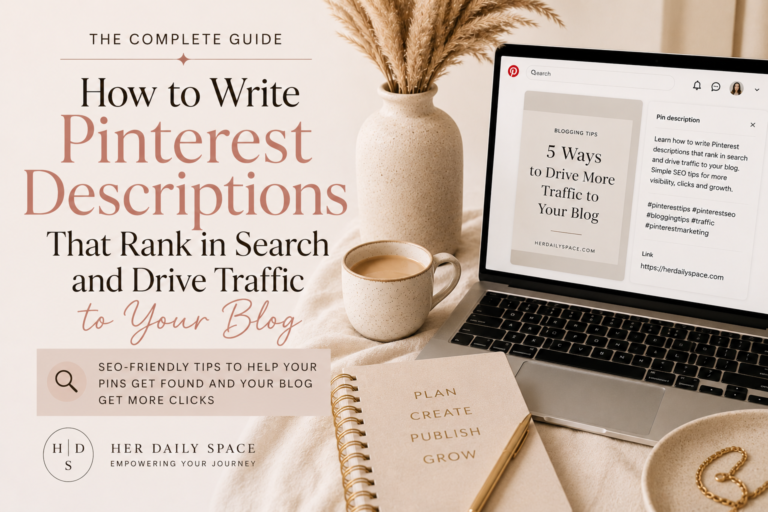
How to Write Pinterest Descriptions That Rank in Search and Drive Traffic to Your Blog
This post contains affiliate links. If you click through and make a purchase or booking, I may earn a small commission at no extra cost to you. The price you pay is exactly the same either way. I only recommend products and experiences I would use myself.
I used to write Pinterest descriptions like captions.
What's In This Post
ToggleWarm, personal, conversational little paragraphs that sounded exactly like how I would describe the content to a friend. Check out this post about my Zanzibar trip. So many tips in here. You are going to love it.
They sounded lovely. They worked terribly.
Not because the warmth was wrong. Because the descriptions contained almost none of the specific language that Pinterest’s search algorithm uses to determine what my content is about and who to serve it to. The algorithm cannot read warmth. It cannot interpret conversational energy as a signal of relevance. It reads words and matches those words to the searches people are performing. And the words in my descriptions were not matching any specific search that anyone was performing because I had not asked what those searches were before I wrote the descriptions.
Once I understood that a Pinterest description is not a caption or a social media post or a piece of creative copy, that it is first and foremost a search signal that also needs to read naturally to a human, my entire approach to writing them changed. And my Pinterest analytics changed with it.
This is everything I know about writing Pinterest descriptions that actually work.
Why Your Pinterest Description Matters More Than Most Creators Realise
Most of the conversation about Pinterest content creation focuses on the visual elements. The pin design. The image quality. The font choices. The colour palette. These things matter genuinely and I have written about them in detail in other posts in this series.
But the description is the element that most directly influences two of the most important things that happen to a pin.
It determines discoverability. Pinterest’s search algorithm reads the words in your description and uses them as signals to understand what your content is about and which searches it is relevant to. A pin with no description or a description containing no searchable language is significantly harder for the algorithm to categorise correctly. It may still appear in some search results based on the visual content analysis Pinterest performs on images. But the text signal is the strongest signal and the absence of it is a meaningful disadvantage.
It converts the impression into a click. When someone sees your pin in their search results or their home feed the description appears below the image and the title. A reader who is almost convinced by the image and title but still slightly uncertain reads the description and either finds the confirmation that this is what they were looking for or does not. A description that clearly explains what the reader will find when they click, in specific and benefit-focused language, converts impressions that might have been scrolled past into clicks that drive traffic to your blog.
The description works simultaneously as an SEO signal for the algorithm and a conversion mechanism for the reader. Writing it well requires serving both audiences at the same time.
Read related post: How to Use Pinterest SEO to Get Your Pins Seen by Thousands of People
What Pinterest's Algorithm Looks for in a Description
Pinterest’s algorithm analyses your description for keyword relevance, which means it looks for the specific words and phrases that match what people are searching for. Beyond simple keyword presence it also appears to evaluate the natural coherence of the text, which is why keyword stuffing, the practice of listing keywords separated by commas or inserting them unnaturally into sentences, produces worse results than naturally written descriptions that happen to include the relevant keywords.
The algorithm is looking for descriptions that would read naturally to a human reader while also containing the specific terminology that indicates relevance to particular searches. This is the balance that a well-written Pinterest description strikes.
The secondary signals the algorithm evaluates include the save-to-impression ratio of the pin, which reflects how useful the audience that finds the pin considers it to be, and the outbound click rate, which reflects how effectively the description convinces the reader to click through. Both of these signals are influenced by the quality of the description. A well-written description that accurately represents what the content delivers produces higher save rates and higher click rates, which in turn tell the algorithm that the pin is genuinely valuable and deserves broader distribution.
Read related post: How to Use Pinterest to Grow Your Blog and Make Money
The Structure of a High-Performing Pinterest Description
A Pinterest description that performs well has a recognisable structure even though the individual elements vary significantly by niche and content type.
The opening sentence hooks the reader and includes the primary keyword naturally. The opening is what the reader sees first when they expand the description and it is the signal the algorithm weighs most heavily in terms of keyword relevance. A strong opening sentence is specific, benefit-focused, and contains the exact phrase or a close variation of the phrase the reader is likely to have searched.
If the pin is for a post about solo female travel in Zanzibar the opening might be solo female travel in Zanzibar is more accessible than most travelers expect, with the right preparation and the right safety knowledge. That opening contains the primary search term naturally, communicates a specific benefit, and creates enough curiosity to encourage continued reading.
The body develops the specific benefit or solves the specific problem the post addresses. After the opening one to three sentences that expand on what the reader will find in the content. Not a summary of every point covered. The most compelling specific element that communicates genuine value.
A natural call to action or indication of what happens when they click. The description does not need a formal click here or link in bio instruction since Pinterest users understand that clicking the pin takes them to the content. But a natural indication of what they will find, here is the complete guide, full packing list on the blog, the honest answer and everything you need to plan your trip, confirms the click is worth making.
How to Research the Right Keywords for Your Description
Keyword research for Pinterest descriptions follows the same process as keyword research for blog content with one additional step specific to Pinterest.
Start with the Pinterest search bar. Type the broad topic of your pin into Pinterest search and observe the autocomplete suggestions. These are the highest-volume searches related to your topic in the language your actual audience uses. The specific phrases that appear in the autocomplete are the phrases you should be incorporating into your descriptions.
Check the guided search tiles. After performing the initial search, look at the coloured filter tiles that appear at the top of the results page. These represent the most common modifiers people add to the initial search. If you search solo female travel and the tiles show Zanzibar, Africa, tips, budget, and safety those modifiers are the specific angles within the broader topic that have the highest search demand. Incorporate the ones most relevant to your specific content.
Read the descriptions of the highest-performing pins in your search results. The pins appearing at the top of your relevant search results have descriptions that Pinterest has determined are relevant to that search. Reading them carefully reveals the language patterns and specific terminology that perform well in that keyword area. This is not about copying. It is about understanding the vocabulary your audience uses when searching for this topic.
Use your blog’s Google keyword research. The keywords that drive traffic to your blog posts through Google are the same keywords people are searching for on Pinterest. Your existing keyword research is directly transferable to your Pinterest description strategy.
Writing Pinterest Descriptions by Content Type
Different types of content require slightly different description approaches. Here is how I approach the most common content types on HerDailySpace.
Travel Content Descriptions
Travel descriptions work best when they combine the destination keyword with the specific angle of the content and a clear statement of who the content is for.
A description for a Zanzibar solo female travel post might read: solo female travel in Zanzibar is genuinely safe and deeply rewarding with the right preparation. Here is everything you need to know before your first trip, from the safest areas to stay and how to get around alone to the cultural considerations that make the experience more respectful and more rewarding. Complete solo female travel guide for Zanzibar on the blog including safety, accommodation, beaches, and the honest travel tips that most guides leave out.
That description includes the primary keyword solo female travel Zanzibar naturally in the first sentence. It specifies the content of the post in concrete terms. It speaks directly to the specific person the content is for. And it ends with a clear indication of what the reader finds on the blog.
Blogging and Income Content Descriptions
Income and blogging content descriptions perform best when they lead with a specific, quantifiable outcome or a relatable situation rather than a generic statement about the content category.
A description for a post about affiliate marketing might read: I spent eight months writing blog content without a single affiliate link and left significant income uncaptured. Here is everything I know about affiliate marketing for bloggers, the programmes that work for specific niches, where to place links for the highest conversion, and the honest income timeline based on five years of building affiliate income from a blog. No theory. Real results and the specific steps that produced them.
That description leads with a specific, relatable situation. It lists the concrete deliverables of the post. It establishes credibility through the five-year experience reference. And it differentiates the content from generic alternatives with no theory, real results.
Self-Care and Healing Content Descriptions
Personal development, healing, and self-care content descriptions work best when they speak directly to the emotional situation the reader is in rather than describing the content in abstract terms.
A description for the survival becomes your religion post might read: when you spend years surviving, building, carrying everyone else, and functioning through difficulty, the self-reliance that kept you going can quietly become the thing that prevents you from receiving the life you worked for. This post is for the woman who arrived somewhere good and realised she does not know how to rest inside it. The healing work of unlearning the survival that served you and learning to trust what is actually here.
That description does not list the points covered in the post. It speaks directly to the feeling that brings the reader to the content in the first place. It creates recognition in the reader who is the intended audience. And it does so while including the natural language around healing, survival mode, and self-reliance that is being searched on Pinterest.
Beauty and Nail Content Descriptions
Beauty content descriptions perform best when they include the specific shade names, skin tone references, or product categories that your audience is actively searching.
A description for the nail colors for dark skin post might read: finding nail colours that genuinely work on dark skin rather than disappearing or clashing requires understanding what the warmth and depth of your skin tone actually complements. Here are twelve nail colour recommendations specifically for dark skin tones, from the chocolate browns and terracottas that look extraordinary in natural light to the milky whites that create the most striking contrast. Honest notes on what works and what consistently fails.
That description includes dark skin, nail colours, specific shade names, and the contrast and undertone language that someone searching for this content would use. It establishes specificity and credibility. And it communicates genuine value by being honest about both what works and what does not.
Read related post: How to Create Pinterest Pins in Canva That Actually Get Clicks
The Disclosure Requirement
If your pin contains an affiliate link you are legally required in most jurisdictions and under Pinterest’s own community guidelines to disclose this in the pin description. The disclosure should be clear and prominent rather than buried at the end.
The most natural format that satisfies both the legal requirement and the platform requirement while not disrupting the readability of the description is placing the disclosure at the end of the description as a parenthetical note. Something like this post contains affiliate links. If you purchase through my links I may earn a small commission at no additional cost to you.
This format is clear, honest, and does not interrupt the description’s primary function of communicating value and encouraging the click. The disclosure is there for anyone who reads to the end and looks for it.
Read related post: How to Make Money on Pinterest Without a Blog: What Actually Works in 2026
The Length Question
Pinterest descriptions have a five hundred character limit displayed in search results and a longer limit for the full description. The question of how long descriptions should be is one I see debated frequently in blogging communities.
My honest answer based on years of testing is that descriptions between one hundred and three hundred characters visible length tend to perform most consistently. Long enough to include the primary keyword and two to three secondary keywords naturally. Long enough to communicate a specific benefit. Short enough that the most important information appears before the reader has to click to expand the description.
Descriptions that are so short they contain only the pin title phrased differently miss keyword opportunities and provide no additional conversion context. Descriptions that are so long they require significant scrolling to read in full risk losing the reader before the key information lands.
The optimal length is the length that naturally includes everything the description needs to do without padding or unnecessary extension.
Common Pinterest Description Mistakes
Writing the description as a social media caption. Check out my latest post! So many amazing tips in here you will love it. This contains no searchable language, no specific benefit, and no reason for the algorithm to understand what the content is about.
Keyword stuffing. Solo female travel solo travel women travel tips women travel packing list. This is a list of keywords, not a description. Pinterest’s algorithm recognises this as low-quality content and may penalise the distribution.
Writing the same description for every pin. Multiple pins pointing to the same blog post should have different descriptions targeting different keyword angles and speaking to different aspects of the content. Identical descriptions on multiple pins signal repetitive content and reduce the keyword reach of your pin library.
Forgetting the call to action or destination indicator. A description that describes the topic beautifully but gives the reader no indication of what they will find when they click misses the conversion opportunity that the description exists to create.
Ignoring the description entirely. A pin published with no description is operating with one of its primary distribution signals missing. Even a brief, naturally written description is significantly better than no description.
Copying descriptions from your blog post introduction. Blog post introductions are written to draw the reader into a long-form piece of writing. Pinterest descriptions are written to convince someone to click through from a visual platform where they are surrounded by competing content. The writing purposes are different and the copy should be different.
A Practical Description Writing Process
This is the process I follow when writing descriptions to ensure I cover everything a strong Pinterest description needs.
Step one: Identify the primary keyword. What is the most specific phrase someone would type into Pinterest to find this exact content. This goes in the first sentence naturally.
Step two: Identify two or three secondary keywords. What related phrases would people also use when searching for this content. These are woven naturally into the description body.
Step three: Write the opening sentence. Include the primary keyword. Communicate a specific benefit or address a specific problem. Make the reader feel like they have found what they were looking for.
Step four: Write one to two sentences expanding on the specific value. What specific things will the reader find in the content. Be concrete rather than vague.
Step five: End with a natural destination indicator. What is on the blog that completes the description’s promise.
Step six: Read it aloud. If it sounds awkward or unnatural when spoken it needs to be rewritten. The keywords should fit naturally into the language rather than interrupting the flow.
Step seven: Check the character count. Ensure the most important information falls within the first two hundred characters that display in search results without requiring expansion.
Faq
How long should a Pinterest description be?
Between one hundred and three hundred characters for the visible portion that appears in search results without expansion. The description can be longer if the additional content genuinely adds value, but the most important keyword and the most compelling benefit statement should fall within the first two hundred characters that display before the read more option appears.
How many keywords should you include in a Pinterest description?
There is no optimal number. The goal is a natural, readable description that includes your primary keyword and two to three related secondary keywords without forcing them into the text unnaturally. Three to five keywords total across a one-hundred-to-two-hundred-character description is a practical target that most well-written descriptions will hit naturally.
Do Pinterest descriptions affect search rankings?
Yes significantly. The description is one of the primary text signals Pinterest uses to determine the relevance of your content to specific search queries. A pin with a keyword-rich, naturally written description consistently outperforms an identical pin with a poor or absent description in search ranking and in overall distribution.
Should every pin for the same blog post have a different description?
Yes. Multiple pin variations for the same blog post should have different descriptions that target different keyword angles, speak to different aspects of the content, and address different potential reader motivations. This multiplies the number of search queries your pins can appear in and reaches different segments of the audience searching for your topic.