How to Start Affiliate Marketing With No Money: A Beginner's Step-by-Step Guide

Quick Answer: Yes, you can start affiliate marketing with no money. Most affiliate programmes are free to join. You can create content on free platforms like Pinterest, YouTube, or social media. When someone buys through your unique tracking link, you earn a commission. The honest trade-off is this: zero financial investment means a higher investment of time, consistency, and patience. You are not escaping the work. You are choosing a different kind of it.
What Is Affiliate Marketing?
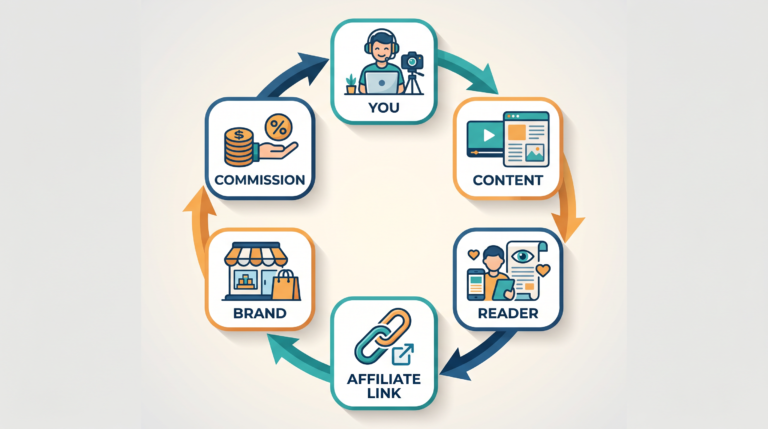
It works like this.
What's In This Post
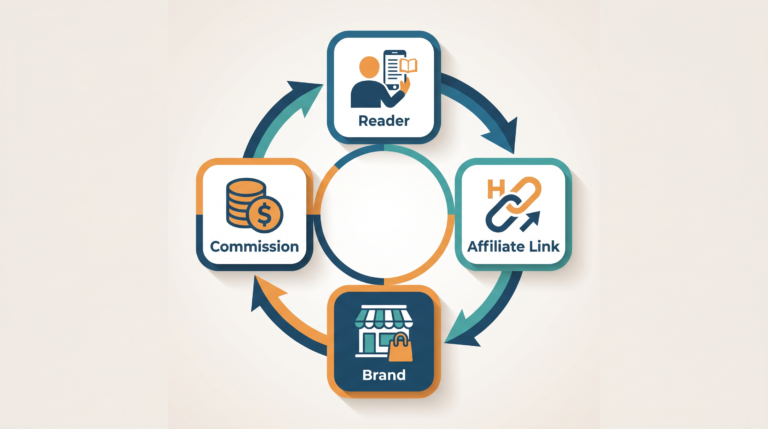
ToggleA brand has a product or service. You join their affiliate programme for free. They give you a unique tracking link. You create content that recommends the product. A reader clicks your link. They buy. You earn a commission.
That is the entire model.
You → Content → Reader → Affiliate Link → Brand → Commission
No product creation. No customer service. No inventory. Your job is to connect the right person with the right product at the right moment.
Can You Really Start Affiliate Marketing With No Money?
Yes. And here is exactly what that means in practice.
What You Actually Need
- A phone or computer
- Internet access
- One clearly defined niche
- One content platform
- One relevant affiliate programme
- Time and consistency
That is genuinely the list.
What You Do NOT Need
- Paid advertising
- Thousands of followers
- An expensive course
- A large email list
- A professional camera
- Dozens of affiliate programmes at once
What No Money Actually Means
This is where most beginner guides are not honest enough.
Zero financial investment does not mean zero investment.
You are investing:
- Time. Content takes time to create and longer to rank.
- Learning. SEO, keyword research, and copywriting are skills you will need to develop.
- Patience. Organic traffic grows slowly. Most people quit before it compounds.
- Experimentation. Your first content will not be your best. That is normal.
If you walk in understanding this, affiliate marketing with no money is completely achievable. If you walk in expecting speed, you will be disappointed.
How to Start Affiliate Marketing With No Money: Step by Step
Step 1: Choose One Niche
A niche is not simply a topic you enjoy. It needs to pass a three-part test.
Audience + Problem + Products
Your niche needs a specific audience searching for help, a real problem that audience is actively trying to solve, and products or services that solve that problem and have affiliate programmes.
| Too Broad | Better |
|---|---|
| Lifestyle | Solo female travel for first-time solo travelers |
| Health | Affordable skincare for women with sensitive skin |
| Finance | Budgeting tools for single mothers |
| Business | Blogging tools for complete beginners |
The narrower your niche the faster you build authority. The faster you build authority the faster you rank. The faster you rank the faster you earn.
Choose one. Start there.
Step 2: Choose the Right Affiliate Products
Not all affiliate programmes are worth your time. Before joining any programme check these:
Relevance. Does the product genuinely solve your audience’s problem? A recommendation that feels forced converts poorly and damages trust.
Quality. Would you recommend this to a close friend? Only promote what you can stand behind honestly.
Commission rate. Physical products typically pay 1 to 10 percent. Digital products and software often pay 20 to 50 percent. Know what you are working with before building content around it.
Cookie duration. This is how long after someone clicks your link you can still earn commission on a purchase. 24 hours is short. 30 to 90 days is standard. Longer is better.
Recurring commissions. Some software programmes pay you every month the customer stays subscribed. One referral can earn repeatedly.
Payment terms. Check the minimum payout threshold and the payment method. Confirm it works for your location before investing time in the programme.
Most established affiliate programmes are free to join, although individual programmes have their own eligibility and approval requirements.
Beginner-friendly programmes to start with:
- Amazon Associates for physical products across almost any niche
- ShareASale for lifestyle, fashion, and home
- Awin for fashion and European brands
- Travelpayouts for travel content
- Impact for technology and software
Step 3: Choose ONE Free Traffic Platform
This is the step where most beginners go wrong.
They try Pinterest and TikTok and Instagram and YouTube simultaneously. They spread themselves across five platforms and build nothing meaningful on any of them.
Choose one. Based on what you actually enjoy creating.
| If You Enjoy... | Start With... |
|---|---|
| Writing and research | Blog or Medium |
| Visual content and design | |
| Teaching and explaining | YouTube |
| Short-form video | TikTok |
| Personal storytelling |
One platform done consistently for six months produces more results than five platforms done sporadically for six months every single time.
Pinterest specific note: Pinterest is the platform I built my own affiliate income on alongside a blog and it is the one I recommend most consistently for beginners because it is a search engine. Content you create today can drive traffic in twelve months. That compounding quality is unlike any other free platform.
Step 4: Create Content Around Problems, Not Products
This is the shift that separates affiliates who earn from affiliates who do not.
Product-first content looks like this:
Best Amazon products for bloggers
The reader was never looking for that article. You brought them to a product before they trusted you enough to act on the recommendation.
Problem-first content looks like this:
How to start a blog with no money
The reader found you because they had a problem. You helped them solve it. You earned their trust. The affiliate recommendation inside the content arrives in a context of genuine helpfulness.
Problem-first content converts better because trust precedes the recommendation.
The three search intents to understand:
- Informational: How does affiliate marketing work? The reader is learning. Not ready to buy yet but building trust.
- Commercial investigation: Best email marketing tools for bloggers. The reader is comparing. Getting close to a decision.
- Transactional: ConvertKit pricing, ConvertKit alternatives, ConvertKit review. The reader is ready to decide. Highest buying intent.
Create content across all three. The informational content builds trust. The commercial and transactional content converts.
How to Get Affiliate Marketing Traffic for Free
Traffic is the engine of affiliate income. Without it the best content earns nothing.
Google SEO
Google is the most valuable long-term traffic source for affiliate content because it is search-based. Someone is already looking for what you wrote.
To get Google traffic:
- Do keyword research before writing anything
- Understand the search intent behind every keyword
- Write content that genuinely serves the person searching
- Build internal links between related posts
- Be patient. Google rankings take months to develop for a new site.
Pinterest is the fastest free traffic source for affiliate content in lifestyle, travel, finance, food, and online income niches.
To get Pinterest traffic:
- Use keyword-rich pin titles and descriptions
- Create vertical 1000 by 1500 pixel pins
- Link every pin to genuinely helpful content
- Post consistently, three to five pins per day minimum
- Treat it as a search engine not a social platform
The HerDailySpace Pinterest guides cover this in full detail. The Pinterest SEO guide and the how to create pins in Canva post are the best places to start.
YouTube
YouTube is the second largest search engine in the world. Tutorial videos, product reviews, and comparison content all work extremely well for affiliate marketing.
One well-ranked YouTube video can drive clicks to your affiliate links for years. The investment is higher than writing but the long-term return is significant.
Social Media
Instagram and TikTok can drive affiliate clicks but the content lifespan is shorter. A post performs for 24 to 72 hours. A ranked Google article or Pinterest pin performs for years.
Social media is good for building an audience. Search engines are better for building passive affiliate income.
How to Do Affiliate Keyword Research for Free
You do not need a paid tool to start.
Google Autocomplete. Type your topic into Google and watch what it suggests completing the phrase with. These completions are based on real searches at real volume.
People Also Ask. The expandable question boxes in Google search results show exactly what your audience is asking. Each question is a potential article.
Related Searches. Scroll to the bottom of any Google results page. The related searches section reveals additional keyword variations worth targeting.
Google Search Console. Once your site is live and connected, Search Console shows exactly which queries are triggering your content. Free and extraordinarily valuable.
Ubersuggest. Free tier available. Provides keyword volume, competition data, and content ideas. Sufficient for beginners.
The simple framework:
Keyword → Search intent → Article → Affiliate offer
Find what your audience searches for. Understand what they want when they search it. Write the article that serves that intent. Include the affiliate recommendation naturally within it.
What Type of Affiliate Content Actually Makes Money?
| Content Type | Example | Buying Intent |
|---|---|---|
| Tutorial | How to start a blog | Medium |
| Review | Best X for beginners | High |
| Comparison | X vs Y | High |
| Alternatives | X alternatives | Very high |
| Best-of list | Best X for Y | High |
| Problem-solving | How to solve X | Medium to high |
Important: Not every article should contain an affiliate link.
Some articles exist purely to build trust and bring new readers in. An article titled how does affiliate marketing work helps a beginner understand the concept. It builds trust. It is not the article where the affiliate link belongs. The article titled best affiliate programmes for beginners is where the link belongs.
Google is clear that good affiliate content adds meaningful original value rather than simply reproducing merchant information. Write content that earns the recommendation before making it.
How to Promote Affiliate Links Without Annoying Your Audience
The fastest way to lose trust is to feel like a sales pitch rather than a helpful resource.
Put the reader’s problem first. The article should solve something genuinely. The affiliate link is the next step, not the purpose.
Explain why you recommend it. Not every affiliate link needs three paragraphs of justification but a brief genuine reason adds credibility that a bare link does not have.
Do not promote products you would not recommend. Your audience will find out. Trust takes months to build and one dishonest recommendation to lose.
Use clear affiliate disclosures. This is both legally required in most countries and the right thing to do for your audience. A simple note that this content contains affiliate links is sufficient and actually builds rather than undermines trust.
Do not put affiliate links in every sentence. One to three natural placements within a helpful article is appropriate. Ten links in five hundred words is not.
Do You Need a Website to Start Affiliate Marketing?
No. But there is an important distinction between starting and building something sustainable.
| Method | Cost | Your Control | Long-Term SEO |
|---|---|---|---|
| Social media | Free | Low | Low |
| Free | Medium | Medium | |
| YouTube | Free | Medium | Medium |
| Blog | Low to free options | High | High |
You can begin on Pinterest or YouTube with zero financial cost and those platforms can drive meaningful affiliate income.
But if your goal is to build a content asset that keeps attracting search traffic and earning commission years from now, a blog gives you more control over the content, the SEO, and the audience relationship than any external platform.
A platform can change its algorithm. It can restrict organic reach. It can shut down. Your blog belongs to you regardless of what any external platform decides.
Start where you can. Build toward owning the asset.
How Long Does It Take to Make Money With Affiliate Marketing?
Honest answer: there is no reliable universal timeline.
Your timeline depends on:
- The competition in your niche
- The quality of your content
- The platform and its algorithm
- How consistently you publish
- How well you understand search intent
- The commission value of what you promote
My personal experience: I spent approximately eight months building before my first meaningful commission arrived. That is not a guarantee it will take eight months for you. It is the honest reality of what it looked like from inside the process.
Anyone promising a specific timeline for a first commission is guessing. Build for the long term and treat early income as validation rather than the destination.
How Much Money Can You Make With Affiliate Marketing?
Rather than giving you income ranges that may bear no relation to your situation, here is the actual economics.
Example scenario:
1,000 visitors per month
× 5% click through rate on affiliate links
= 50 affiliate link clicks
50 clicks
× 4% conversion rate
= 2 sales
2 sales
× $30 commission per sale
= $60 per month
Scale the traffic. Improve the conversion rate. Increase the commission value. The income grows proportionally.
The variables that most determine your income are niche profitability, traffic volume and quality, and the match between your content and the buyer’s intent. All three improve with time and experience.
Your First 30 Days of Affiliate Marketing With No Money
Week 1: Choose
- Choose your niche using the audience, problem, product framework
- Identify your target reader specifically
- Join one relevant affiliate programme
- Choose one traffic platform based on what you genuinely enjoy creating
Week 2: Build
- Set up your chosen platform
- Research 10 to 20 specific keywords your audience searches for
- Publish your first piece of content. Do not wait for it to be perfect.
Week 3: Distribute
- Create Pinterest pins for your content if Pinterest is your platform
- Add internal links connecting your content pieces
- Publish your second and third content pieces
Week 4: Measure
Look at:
- Impressions and reach
- Click-through rates
- Any affiliate link clicks
- Which content is getting the most engagement
Then do the most important thing.
Do not change everything because you have not made money in four weeks.
Month one is always the investment period. The returns come later. Changing direction at week four resets the clock every time.
Common Affiliate Marketing Mistakes Beginners Make
- Choosing a niche that is too broad. You cannot rank for everything. Narrow down.
- Promoting too many products at once. Depth of recommendation converts better than breadth.
- Joining too many affiliate programmes immediately. Two or three relevant programmes are more manageable and more focused than fifteen scattered ones.
- Creating content nobody searches for. Do keyword research before writing. Every time.
- Focusing on follower count instead of traffic quality. 200 buyers-intent visitors are worth more than 20,000 passive scrollers.
- Expecting income within weeks. The timeline is months. Build accordingly.
- Buying expensive tools and courses before earning anything. Start free. Invest once the income justifies it.
- Ignoring SEO. The best content that nobody finds earns nothing.
- Not disclosing affiliate links. Required by law in most countries. Non-negotiable.
- Quitting before the content compounds. The income arrives after the compounding begins. Most people quit just before it starts.
Is Affiliate Marketing Worth It If You Have No Money?
Yes, if:
- You are willing to invest consistent time over months
- You can create content regularly without immediate financial reward
- You understand and accept the realistic timeline
- You are prepared to learn SEO, content creation, and basic marketing
- You choose one focused niche and stay with it
Probably not, if:
- You need guaranteed income in the next four to six weeks
- You are not willing to create content consistently
- You expect passive income before doing the active work to set it up
- You want results without a learning curve
Affiliate marketing is a genuine income model with a genuine timeline. Neither overstating nor understating that is honest.
FAQ
Can I start affiliate marketing with absolutely no money?
Yes. You can join programmes for free, create content on free platforms, and earn commissions without spending anything. The investment is time and consistency rather than money.
Can I do affiliate marketing without a website?
Yes. Pinterest, YouTube, TikTok, and Instagram can all drive affiliate clicks without a blog. A website gives you more long-term control and better SEO potential but it is not required to start.
What is the best affiliate programme for beginners?
Amazon Associates is the most accessible starting point because the approval process is straightforward and the product range covers almost any niche. Travelpayouts is the best single network for travel content. ShareASale and Awin are strong options for lifestyle and fashion niches.
How do I promote affiliate links for free?
Create genuinely helpful content on a free platform, a Pinterest account, a YouTube channel, a blog on a free platform, and include your affiliate links naturally within that content where they are relevant and useful to the reader.
How do I get affiliate marketing traffic without social media?
Google SEO through a blog and Pinterest as a search engine are both search-based traffic sources that do not require a social media following. Both take longer to develop than social platforms but produce more consistent and more passive traffic over time.
How long does it take to make the first affiliate commission?
There is no reliable universal answer. Some people earn a first commission within weeks. Others take six to twelve months. The timeline depends on niche competition, content quality, traffic platform, and consistency of publishing. Expect months rather than weeks and you will be neither surprised nor disappointed.
Can I do affiliate marketing with no followers?
Yes. Search-based platforms like Google and Pinterest distribute content based on relevance rather than follower count. A new account with no followers can rank for specific searches and drive affiliate clicks from day one if the content is well-optimised.
Is affiliate marketing still worth it in 2026?
Yes. The mechanism, recommending a product and earning commission when someone buys, is not going anywhere. The approach that works has shifted toward genuinely helpful, experience-based content rather than thin product lists. High-quality content in a specific niche continues to produce meaningful passive affiliate income for creators who build it correctly.
Do I have to disclose affiliate links?
Yes. In most countries including the United States, the United Kingdom, and most of Europe, affiliate link disclosure is legally required. In the US the FTC requires clear and conspicuous disclosure. Beyond the legal requirement, disclosure builds trust with your audience rather than damaging it.
You Do Not Need to Figure Out Your Entire Online Business Today
You need to choose a direction that makes sense for your specific situation and take the right steps from where you actually are.
Affiliate marketing is one of several legitimate income paths available to someone building online income from zero. It is not the right path for everyone. But for someone with time, a specific niche, and the patience to build something that compounds, it is one of the most genuinely passive income models available.
If you are still figuring out whether affiliate marketing is the right path for you, or whether a different income model would produce faster or better results for your specific situation, that is exactly the kind of decision the Crossroads Blueprint was created to help you work through.
Not another course. A personalised conversation about which direction makes sense for you.
Explore the Crossroads Blueprint →
With love,
Nia