Affiliate Marketing vs Dropshipping: Which Is Better in 2026? I Tried Both

Quick Answer: Affiliate marketing and dropshipping are both legitimate online income models but they suit completely different types of people. Affiliate marketing is operationally simpler, requires less money to start, and works well for content creators. Dropshipping gives you more control over pricing and the customer experience but comes with more operational responsibility. The right choice depends on what you actually want to build and how you want to spend your time.
I Tried Both. Here Is What Actually Happened.
I want to be honest with you about something before this comparison starts.
What's In This Post
ToggleI did not approach dropshipping as a casual experiment. I approached it the way most beginners do. With genuine hope, a YouTube education, and the belief that if I set up the right store with the right products I would build a real income stream.
What I expected: a store that would start generating sales, a supplier relationship that would handle the fulfilment, and an income that would grow as I scaled the marketing.
What actually happened: I spent more time and money than I had planned managing supplier issues, testing products that did not convert, running advertising that ate into margins before I had established what was working, and dealing with the operational complexity of a business model that requires you to own the customer experience for a product you never touch.
The income did not compound the way I had imagined. The costs did.
Eventually I redirected my energy toward affiliate marketing. It took months before the first meaningful commission arrived. It was not overnight. It was not easy. But the income that eventually came was from content I had created once that kept earning long after I had moved on to creating something else.
My blogs eventually paid for my house. That is the honest version of where the two models took me.
The Short Answer
If you have very little money, prefer creating content, and want lower operational complexity, affiliate marketing is usually the simpler place to start.
If you want to build your own store, control your pricing, and own the customer relationship, dropshipping gives you more control but also more responsibility.
But simpler does not mean better. The right choice depends entirely on what you actually want to build and which kind of work you are genuinely willing to do consistently over time.
At a Glance: Affiliate Marketing vs Dropshipping
| Factor | Affiliate Marketing | Dropshipping |
|---|---|---|
| Startup cost | Very low | Low to medium |
| Inventory | None | None owned upfront |
| Customer service | Usually none | Yes, you own this |
| Pricing control | No | Yes |
| Profit per sale | Commission percentage | Selling price minus costs |
| Website required | Not always | Usually yes |
| Main skill needed | Content creation and trust | Marketing, sales, operations |
| Financial risk | Lower | Higher |
| Long-term asset built | Audience and content | Store, brand, customer base |
| Best suited to | Content creators | Store builders |
| Speed to first test | Fast | Moderate |
What Is Affiliate Marketing?
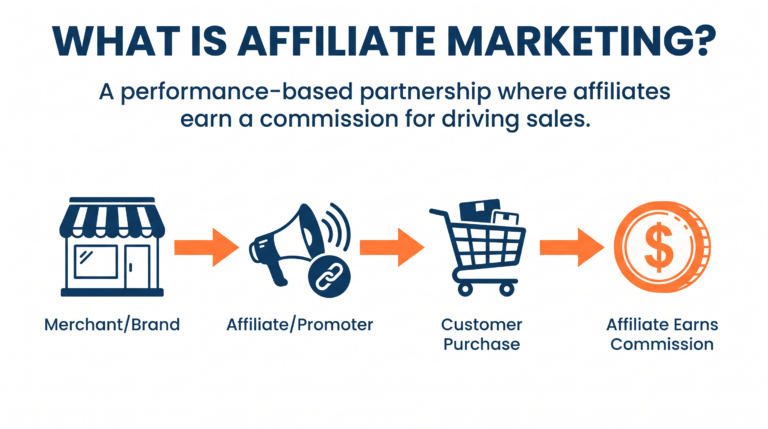
The model is straightforward.
You recommend a product or service through your content. A reader clicks your unique tracking link. They buy the product. You earn a commission.
You → Content → Reader → Affiliate Link → Brand → Purchase → Commission
You never own the product. You never handle fulfilment. You never manage customer service. Your role is to create content that connects the right person with the right product at the right moment.
My affiliate income did not appear immediately. The first meaningful commission arrived after months of publishing content and waiting for it to rank in search results. Nothing passive happened until the active work of building was done first.
That is the honest version of how affiliate marketing works. Not overnight. Not effortless at the start. Genuinely compelling once the compounding begins.
What Is Dropshipping?
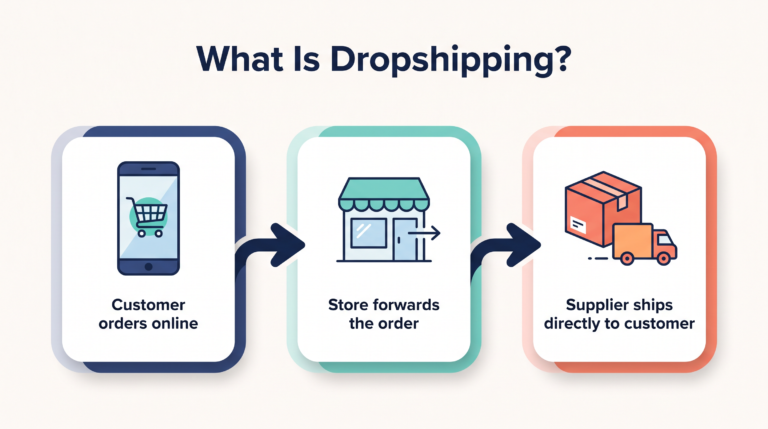
The transaction works like this.
A customer finds your store. They place an order and pay you. You forward the order to your supplier. The supplier ships directly to the customer. The difference between what the customer paid you and what you paid the supplier is your potential profit before costs.
Customer → Your Store → Payment → Supplier → Fulfilment → Customer
The critical distinction from affiliate marketing is this.
With affiliate marketing you recommend someone else’s product. With dropshipping you are selling the product through your store. That single difference creates almost every other difference in this comparison.
You own the checkout. You own the customer service. You own the return and refund process. You own the reputation that the customer builds with your brand based on the experience your supplier delivers.
You control more. You are responsible for more.
How the Money Works
Affiliate Marketing
Sale value × commission rate = your income
Example:
$100 product × 10% commission = $10 per sale
Commissions range widely. Physical products on Amazon pay 1 to 10 percent. Digital products and software often pay 20 to 50 percent. Recurring commission programmes pay monthly for as long as the customer stays subscribed.
Dropshipping
Selling price − supplier cost − platform fees − marketing − other operating costs = profit before tax
Example:
$50 selling price
− $20 supplier cost
− $10 marketing and platform fees
= $20 potential profit before other expenses
Dropshipping gives you more control over the economics of each sale. You set the price. You choose the margin. The trade-off is that you absorb all the associated costs and responsibilities.
Affiliate marketing gives you less control over the economics. The merchant sets the commission. You cannot negotiate the rate. But you also carry none of the operational cost.
Startup Costs: What You Actually Need
Affiliate Marketing
- A content platform. This can be free through Pinterest, YouTube, or a social account.
- A domain and hosting if you choose a blog. Approximately $50 to $150 per year.
- Optional tools like Canva for design or an email marketing platform.
- Time. This is the real cost of affiliate marketing.
It is genuinely possible to start affiliate marketing with zero financial investment. The guide to starting affiliate marketing with no money covers this in full detail.
Dropshipping
- An ecommerce platform. Shopify starts at approximately $29 per month.
- A domain.
- Store design and setup time.
- Product and supplier research.
- Testing budget for products before committing to them.
- Marketing. Organic traffic takes time. Paid advertising produces faster results and costs money.
You can start a dropshipping store on a minimal budget. But the operational costs of running a functioning store with paid traffic testing are genuinely higher than starting an affiliate marketing content strategy.
Which Is Easier?
Depends entirely on what you mean by easier.
| If easier means... | Winner |
|---|---|
| Cheapest to start | Affiliate marketing |
| Fastest setup | Affiliate marketing |
| No customer service | Affiliate marketing |
| No fulfilment management | Affiliate marketing |
| Building your own store | Dropshipping |
| Controlling your pricing | Dropshipping |
| Owning the customer relationship | Dropshipping |
Affiliate marketing is operationally simpler. Dropshipping is not necessarily difficult but there are more things that become your direct responsibility from the first day.
Which Makes More Money?
The honest answer is that neither model guarantees income and income potential is not the same thing as profit.
Affiliate marketing income levers
- Search engine traffic that compounds over time
- Pinterest content that drives traffic for months or years
- Email list that converts into commissions repeatedly
- Multiple affiliate programmes across one content platform
- Recurring commission programmes that pay monthly
Dropshipping income levers
- Pricing control that allows margin optimisation
- Upsells and bundles that increase average order value
- Repeat customer purchases from the same store
- Brand building that creates long-term customer loyalty
The affiliate marketer who builds genuine SEO authority over twelve to eighteen months can generate significant passive commission income. The dropshipper who finds winning products and builds a recognisable store brand can generate significant margin income.
Neither is consistently more profitable. Both reward strategic thinking and consistent execution. The model that makes more money for you is the one you build more consistently over time.
Which Is More Passive?
Affiliate marketing over time
Content is created → Content ranks in search → Traffic arrives → Clicks happen → Commissions arrive
Once content ranks it can continue generating traffic and commission without daily active involvement. The passive quality builds gradually after months of active content creation.
Dropshipping even when automated
Traffic arrives → Order placed → Payment processed → Supplier notified → Fulfilment executed → Customer contacted → Support managed
You own more of the operational chain. Even with automation tools there are more components that require your attention when things go wrong.
Important: Affiliate marketing is not passive at the beginning. I want to say this clearly because the opposite claim is responsible for a significant amount of beginner disappointment.
The first months are active months. Creating content. Waiting for rankings. Building trust. The passive quality develops after that foundation is in place. If you start with the expectation of passive income immediately you will be disappointed by both models.
Risk Comparison
| Risk | Affiliate Marketing | Dropshipping |
|---|---|---|
| Losing money on startup | Very low | Low to medium |
| Supplier problems | None directly | Significant |
| Customer complaints | Low | High |
| Commission rate changes | Yes, merchants control this | Not applicable |
| Product quality control | None | Limited |
| Advertising risk | Optional | Often significant |
| Reputation risk | High | High |
| Platform dependence | Medium | Medium to high |
The risk is not eliminated with either model. It is shifted.
With affiliate marketing the merchant controls the commission rate, the product, and the checkout experience. Your risk is that the programme changes terms, reduces commissions, or closes. Your content asset remains but the income stream attached to it can shift.
With dropshipping the supplier controls product quality and fulfilment speed. Your risk is that supplier problems, shipping delays, or quality issues create customer complaints that damage the reputation of a store you are actively building.
Both models carry reputation risk. Recommending a bad product damages affiliate trust. Delivering a poor customer experience damages store brand trust. In both cases trust is the asset and it takes longer to build than to lose.
Who Owns the Customer?
This is the distinction that creates every operational difference between the two models.
Affiliate marketer
The customer completes their purchase on the merchant’s website. The merchant owns the checkout, the customer data, the fulfilment, and the post-purchase relationship. You earn a commission and the transaction is complete from your end.
Dropshipper
The customer completes their purchase in your store. You own the checkout, the customer data, the customer service relationship, the returns process, and everything that happens between payment and delivery.
That ownership is the control that dropshipping offers. It is also the responsibility that dropshipping requires.
If you want to build a customer base that you own and market to repeatedly, dropshipping gives you that. If you want to earn from customer relationships that someone else manages, affiliate marketing gives you that.
Neither is superior. They are different business philosophies.
Which Requires More Marketing?
Which Requires More Marketing?
Affiliate marketing traffic sources
- Google SEO through blog content
- Pinterest as a search-based visual platform
- YouTube tutorials and reviews
- Email list marketing
- Social media content
The content itself is the primary marketing tool. A well-ranked article or a well-optimised Pinterest pin continues driving traffic without ongoing active promotion.
Dropshipping traffic sources
- Meta advertising
- TikTok advertising
- Google Shopping and search ads
- Influencer partnerships
- SEO and organic social
Dropshipping more frequently relies on paid advertising to generate store traffic quickly, which introduces advertising spend as an ongoing cost variable that affiliate marketing content does not necessarily require.
Affiliate marketing tends to make the content itself the recommendation vehicle. Dropshipping tends to make paid marketing the engine that brings people into the purchase funnel.
Which Is Better for Different Beginners?
| If you... | Consider... |
|---|---|
| Have almost no money | Affiliate marketing |
| Enjoy writing and creating content | Affiliate marketing |
| Use Pinterest or YouTube | Affiliate marketing |
| Already have an audience | Affiliate marketing |
| Want to build a personal brand | Affiliate marketing |
| Like SEO and search strategy | Affiliate marketing |
| Want your own online store | Dropshipping |
| Enjoy product research | Dropshipping |
| Are comfortable with paid advertising | Dropshipping |
| Want pricing control | Dropshipping |
| Want to build a store brand | Dropshipping |
| Enjoy customer and business operations | Dropshipping |
Start with the model that matches the work you actually enjoy doing. Not the one that sounds most appealing in a YouTube video. The one whose daily activities you can sustain across twelve months.
What I Would Choose With $0 Today
Affiliate marketing. Without hesitation.
Not because dropshipping cannot work. It clearly can for the right person in the right execution. But because of what the two models actually require from the person building them.
With affiliate marketing and zero dollars today I would:
- Open a free Pinterest business account
- Choose a specific niche with buyer-intent search demand
- Join two or three relevant affiliate programmes for free
- Create keyword-optimised pins linking to helpful content
- Build an email list with a free lead magnet
- Eventually add digital products to the same content platform
Every step above is free or close to it. The income builds through content compounding rather than through advertising spend. The asset I am building is the content library and the audience trust, and both of those stay mine regardless of what any supplier or platform decides.
The house I mentioned at the beginning of this article came from that model. Slowly. Then consistently. Then significantly.
Why I Failed at Dropshipping
I underestimated three things.
The product testing cost. Finding a winning product in dropshipping requires testing. Testing requires traffic. Traffic from paid advertising costs money before you know whether the product will convert. The testing phase consumed more budget than I had planned before the winning product was identified.
The supplier dependency. I was building a customer experience I could not fully control. When supplier fulfilment was slow the customer complaint was addressed to me. When product quality was inconsistent the return was processed through me. The distance between my store brand and my actual ability to control the product experience was more uncomfortable than I had anticipated.
The operational volume. At the scale where dropshipping income becomes meaningful, the operational management of orders, customer service, supplier communication, and marketing requires either your time or your money to outsource. The model scales but it does not scale quietly.
What I would do differently: start with a single product in a niche I genuinely understood, use organic traffic testing before committing to paid advertising spend, and be more honest with myself upfront about whether I wanted to run an ecommerce operation or build a content asset.
Can You Do Both Together?
Yes. And at a more advanced stage the combination is genuinely powerful.
A content platform building affiliate income through a blog or Pinterest presence can eventually add a dropshipping store or a digital product store to the same audience. The content builds the trust. The store monetises it in a different way.
But do not start with both.
Start with one model until you understand traffic, conversion, and what your audience responds to. Then add the second model once the first is producing consistent results.
The beginner who starts both simultaneously usually does neither well enough to produce results from either.
Pros and Cons
Affiliate Marketing
Pros:
- Very low startup cost
- No inventory management
- No fulfilment or shipping
- No customer service in most cases
- Evergreen content can produce passive income over time
- Multiple traffic sources available including free ones
- Can be started alongside a full-time job
Cons:
- You do not control the commission rate
- Merchants can close programmes or reduce payouts
- The merchant owns the customer checkout
- Trust takes time to build
- Organic traffic takes months to develop
- Income depends on the merchant’s product converting
Dropshipping
Pros:
- Full control over pricing
- You build and own your store brand
- Potential for repeat customer purchases
- More control over product selection
- Customer data belongs to you
- Can scale with advertising spend
Cons:
- Customer service is your responsibility
- Supplier problems become your problem
- Returns and refunds are managed by you
- Product quality is partly out of your control
- Marketing costs can be significant
- More operational complexity than affiliate marketing
My Final Verdict
Choose affiliate marketing if you want:
- Low financial risk to start
- A content-based business model
- Geographic and time flexibility
- SEO and Pinterest as primary traffic sources
- No customer service or fulfilment responsibility
- An income that builds from content rather than advertising spend
Choose dropshipping if you want:
- Your own ecommerce store
- Pricing and margin control
- A customer base that belongs to you
- Product branding opportunities
- A business that scales with advertising investment
For me, affiliate marketing was the right choice. Not because dropshipping is a worse model. Because the kind of business I wanted to build, one based on content, trust, and compounding organic traffic rather than on advertising spend and operational management, aligned with affiliate marketing in a way it did not align with dropshipping.
The house is the evidence. The model is the explanation.
FAQ
What is the difference between affiliate marketing and dropshipping?
With affiliate marketing you recommend someone else’s product and earn a commission when someone buys through your link. With dropshipping you sell products through your own store, forward orders to a supplier who ships directly to the customer, and keep the margin between your selling price and the supplier cost. The merchant owns the product in both cases but the dropshipper owns the customer relationship and the affiliate marketer does not.
Is affiliate marketing better than dropshipping?
It depends on what you want to build. Affiliate marketing is simpler operationally and lower risk financially. Dropshipping gives you more control over pricing, the customer experience, and the brand you are building. Neither is universally better. The right model depends on your skills, your timeline, and the type of business you actually want to run.
Is dropshipping more profitable than affiliate marketing?
Not necessarily. Dropshipping gives you control over margins but also introduces more costs including advertising, platform fees, and returns. Affiliate marketing commissions are smaller per sale but require no operational costs after content creation. Long-term profitability depends on execution quality in both models rather than on which model is inherently more profitable.
Which is easier for beginners?
Affiliate marketing has fewer moving parts for a beginner. No store setup. No supplier relationships. No customer service. Start with content on a free platform and a free affiliate programme. Dropshipping has more components that require simultaneous management from the beginning.
Can I start affiliate marketing with no money?
Yes. A Pinterest business account is free. Many affiliate programmes are free to join. A Canva free account is sufficient for creating pins. The investment is time rather than money at the starting point.
Can I start dropshipping with no money?
Not entirely. A functioning dropshipping store requires at minimum an ecommerce platform subscription, a domain, and a marketing budget for generating traffic. The costs are lower than traditional retail but they are genuinely present from the beginning.
Which requires more work?
Different types of work rather than more or less of it. Affiliate marketing requires consistent content creation and search strategy. Dropshipping requires store management, supplier coordination, customer service, and marketing management. Both require significant work to produce meaningful income. Neither is a passive starting point.
Which has less risk?
Affiliate marketing carries less financial risk because the startup costs are lower and there is no advertising spend required to test whether the model works. Dropshipping introduces supplier risk, advertising risk, and customer service risk from the beginning.
Which is more passive?
Affiliate marketing becomes more passive over time as content compounds in search rankings. Dropshipping requires more ongoing operational management even as it scales. Both require active work before any passive quality develops.
Can you do affiliate marketing and dropshipping together?
Yes, and at a more advanced stage the combination is powerful. A content platform builds trust and affiliate income. A store serves the same audience with a different monetisation model. Start with one. Add the other once the first is producing consistent results.
Do you need a website for affiliate marketing?
Not necessarily. Pinterest, YouTube, and social media can all drive affiliate clicks without a blog. A website gives you more long-term SEO control but it is not required to start.
Do you need a website for dropshipping?
Yes. A dropshipping business requires an ecommerce store where customers complete their purchases. Shopify is the most common platform for this purpose.
Still Figuring Out Which Online Income Model Is Right for You?
Affiliate marketing and dropshipping are two options in a longer list of legitimate online income paths. Neither is universally right. Both require honest assessment of what you actually want to build and what you are genuinely willing to do consistently over time.
If you are still figuring out which model fits your specific skills, your available time, and your income goals, that is the exact decision the Crossroads Blueprint is designed to help you work through.
Not a generic recommendation. A personalised conversation about your specific starting point.
Explore the Crossroads Blueprint →
With love,
Nia