
Journaling Techniques That Actually Help Me

Quick Answer: Journaling is one of the most useful self-understanding tools available and you do not need a perfect notebook, a specific routine, or any idea what you are doing to begin. The most effective journaling techniques are the ones that give your honest thoughts somewhere to land. This guide covers ten techniques, twenty journaling ideas, thirty prompts, and how to start tonight even if you have never journaled before.
I did not start journaling because I had it together.
What's In This Post
ToggleI started because I did not.
There were things I could not say out loud. Feelings I did not fully understand yet. Family situations I kept replaying without resolution. Questions about what I actually wanted from my own life that felt too vulnerable to ask anyone and too heavy to keep carrying alone.
The journal gave me somewhere to put all of it.
Not somewhere to perform clarity I had not yet found. Not somewhere to sound like I was handling things better than I was. Somewhere to be completely honest with myself in a way that the pace of daily life does not naturally create space for.
That is where the journaling started. What it became is something I did not expect.
The more consistently I wrote, the better I understood why I responded to things the way I did. Why certain situations triggered feelings that felt too large for what was actually happening. What I actually wanted versus what I had been performing. Who I was becoming versus who I had been trying to stay.
Journaling did not give me answers. It gave me the quiet to finally hear the questions.
This article is everything I have learned about journaling techniques that actually help, for the woman who does not know where to start or who has started and stopped and is looking for a way back in.
What Is Journaling, Really?
Before the techniques, a clarification.
Journaling is not the same as keeping a diary.
A diary records what happened. A journal explores what it meant.
Diary: I had a difficult conversation with my mother today.
Journal: I had a difficult conversation with my mother today. I noticed I immediately apologised for bringing it up. I wonder how long I have been doing that. I wonder what I am still afraid will happen if I do not apologise first.
That distinction is the difference between documentation and self-understanding. Both have value. The second one is what we are talking about here.
Journaling can mean different things at different times.
- Writing about thoughts you cannot stop circling
- Recording experiences and what they revealed
- Processing emotions that have not yet found words
- Exploring questions without forcing premature answers
- Documenting goals and what is getting in the way of them
- Reflecting on patterns you are beginning to notice
- Writing without any particular purpose beyond getting it out
There is no single correct version of journaling. The version that works is the one you actually do.
Why I Started Journaling
I needed somewhere to process what I could not say
Some things are too complicated to explain to another person before you have understood them yourself. The feeling that arrives in the middle of the night without a name. The grief that does not fit a specific event. The anger that feels unreasonable even as you are feeling it.
The journal does not need you to have already figured out what you mean. It holds the not-yet-figured-out version of your thinking without requiring it to be presentable.
I wanted to understand my patterns
When I started doing the healing work around my childhood, I began noticing patterns I had not consciously seen before. The way I automatically took responsibility for other people’s emotional states. The way conflict made me want to immediately disappear into an apology. The way I over-explained my decisions before anyone had questioned them.
Writing about these patterns in the journal was part of how I moved from noticing them to actually understanding them. The act of writing gave the pattern enough form to examine.
I was tired of carrying everything around in my head
Thoughts that circulate without resolution are exhausting in a specific way. The same question returning each morning without movement. The same feeling cycling without anywhere to go.
Writing gives the thought somewhere outside of you to exist. It creates the distance needed to look at what is actually there rather than simply being inside it.
Journaling helped me hear myself
In a life with a daughter, a business, and every other obligation that makes up a full daily existence, my own voice was often the quietest one. The one that got answered last. The one I told to wait until there was more time.
The journal was one of the first consistent practices I built that was specifically designed to hear that voice rather than quiet it further.
I started realising what I actually wanted
This is the connection to the manifesting work. You cannot write honestly in a journal for any sustained period without beginning to encounter what you actually want underneath what you have been performing. The journal was where the desire started to have form before it had a plan.
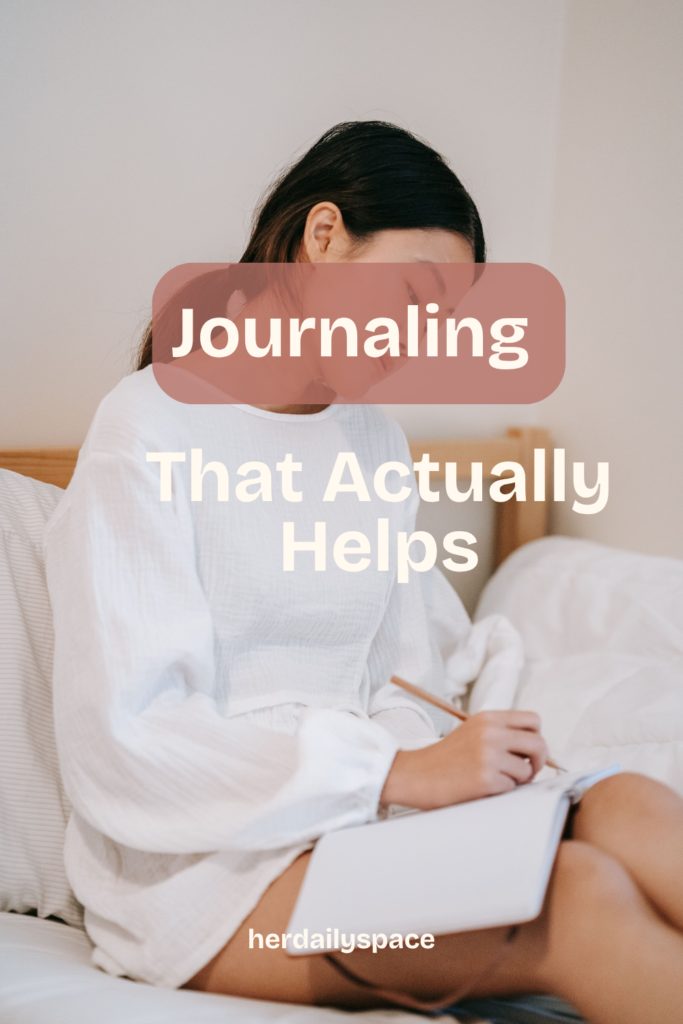
10 Journaling Techniques That Actually Help Me
1. Free Writing
Write whatever comes to mind without editing, correcting, or judging it.
The rules are simple. Keep the pen moving. Do not cross things out. Do not read back until you have finished. Do not write what sounds good. Write what is true.
This technique works specifically because it removes the performance layer. Most of us are so accustomed to monitoring what we say and how we say it that genuinely unfiltered honest writing requires a specific kind of permission. Free writing is that permission, given to yourself on paper.
Start with five minutes. Extend it as the practice becomes more natural.
2. Stream-of-Consciousness Journaling
Write continuously for a set time, usually five to ten minutes, without stopping to think, plan, or evaluate.
This technique is particularly useful when you do not know what you are feeling. The stream-of-consciousness approach bypasses the part of the mind that wants to organise and present and goes directly to whatever is actually present underneath.
What often emerges surprises the writer. The thought she did not know was there. The feeling she had been managing without acknowledging. The thing she already knew the answer to but had been avoiding.
3. Prompt Journaling
Use a specific question to open the door when free writing feels too unstructured.
A prompt gives the pen something to respond to when your own mind has nothing obvious to offer or when resistance to beginning feels strong.
The best prompts for honest self-understanding are the ones that feel slightly uncomfortable to answer. The slight discomfort is usually pointing directly at something worth exploring.
Start with: What am I pretending not to feel right now?
4. Gratitude Journaling
Not the clichéd version. Not a rote list of three things that feels more like homework than honesty.
The version that works is more specific.
What was good today that I almost overlooked? What is present in my life right now that I would genuinely miss if it were gone? What happened this week that I did not acknowledge as the thing it actually was?
Gratitude journaling works not because positive thinking transforms your circumstances but because deliberate attention to what is already present shifts the internal baseline from scarcity to recognition. That shift matters more than it sounds.
5. Reflection Journaling
A structured examination of something that happened.
What happened? Write it plainly without editorial.
How did I feel? Name as many feelings as were present. Not just the surface one.
Why did it affect me the way it did? This is the important question. The disproportionate reaction points to something older than the current situation.
What does this tell me? About myself, about the relationship, about the pattern, about what I need.
This technique transforms experiences from things that happened to me into information about me. That distinction is the heart of self-understanding through journaling.
6. Future-Self Journaling
Write from the perspective of the woman you are becoming. Not who you wish you were. Not a fantasy version of a different person. The woman who has continued on the path you are currently on with the intention and the consistency you are working to maintain.
What does her morning look like? How does she make decisions? How does she respond to difficulty? What has she released that you are still carrying?
This technique connects directly to the manifesting work. Writing from the future self creates enough internal familiarity with that version of you that the decisions of the present begin to align with where you are headed rather than where you have been.
7. Emotional Dump Journaling
Put the messy thoughts on paper without trying to organise, resolve, or solve them.
This is not a technique for producing clarity. It is a technique for producing space. The emotions that have been circulating without anywhere to go get deposited onto the page. The mind, having been relieved of the burden of holding them, often finds clarity naturally after the dump is complete.
No structure required. No conclusions necessary. Write until the charge has dissipated enough to breathe differently.
8. Letter Journaling
Write a letter you may never send.
To a parent. To a sibling. To a past version of yourself. To your daughter. To the person who hurt you. To the version of yourself who is still hurt. To the future woman you are becoming.
This technique creates an intimacy and a directness of address that other journaling techniques do not produce. When you are writing to someone specific, even someone who will never read the letter, the writing becomes more honest because it is addressed somewhere.
The letters I have written to people in my journal, letters that exist only on those pages and nowhere else, have produced some of the most significant realisations of my healing process. Things I did not know I needed to say until I wrote them to the person who needed to receive them.
9. Boundary Journaling
A specific technique for examining the places where your boundaries are unclear, absent, or being crossed.
Where did I say yes today when I wanted to say no?
Where am I over-explaining a decision that requires no explanation?
What boundary would make this relationship feel safer?
What am I afraid will happen if I say no?
Where am I giving energy I do not have to give?
This technique connects directly to the healing work. The pattern of not setting boundaries has roots that the journal can help you trace. Writing regularly about where your boundaries are being tested surfaces the information you need to understand why the pattern persists and what it would take to change it.
10. Question Journaling
Instead of writing answers, write better questions.
What am I actually afraid of? What do I actually want? What would I choose if I was not managing how it would land with other people? What does this feeling underneath the feeling actually mean?
The best questions are the ones that do not yet have an answer that feels complete. Write the question and then live with it for a few days. Return to it. Write the question again. Notice whether the answer has changed or deepened.
Some of the most important journaling I have done has been nothing more than a question and then space to let the question breathe.
How to Start Journaling When You Do Not Know What to Write
Start with five minutes
Not an hour. Not a whole morning practice. Five minutes with a specific question or a blank page and permission to write whatever arrives.
The practice becomes natural with repetition. Five minutes of honest writing done consistently produces more than an occasional hour done whenever you feel inspired.
Do not worry about writing well
The journal is not a writing performance. No one is grading it. The comma does not need to be in the right place. The thought does not need to be fully formed before it arrives on the page.
Write messily. Write in fragments. Write the same sentence three times in slightly different ways. The quality of the writing is irrelevant. The honesty of it is everything.
Pick one question
If the blank page feels too large, give yourself a door in. One question. Write your answer to it. Let that be enough for today.
Tomorrow you can use a different question or return to the same one and see what has shifted.
Write by hand or type
Whatever you will actually do is the right choice.
There is something about handwriting that produces a different quality of thought than typing. The slower pace. The physical connection to the pen on the page. Many writers find that handwriting reaches deeper than typing.
But a typing practice sustained over months produces more than a handwriting practice that does not happen.
Choose the format that removes as many barriers as possible to the actual practice.
Do not force yourself to journal every day
Consistency is more important than frequency. Three times a week that actually happens is more useful than a daily practice you guilt yourself out of by day four.
Build the frequency around what is sustainable in your actual life rather than in the ideal version of your life.
Stop trying to have the perfect journal
The beautiful notebook that feels too precious to write in. The app that requires too much setup. The journal that lives inside a self-improvement programme so elaborate that the journaling itself gets buried under the architecture.
Start with whatever paper is in front of you. The practice is in the writing. Not in the container.
20 Journaling Ideas for When You Have Nothing to Write About
For Self-Discovery
- What do I want right now, if I am being completely honest?
- What am I pretending does not bother me?
- What makes me feel most like myself?
- What have I outgrown that I am still carrying?
- What do I know about myself that I have not yet admitted out loud?
For Healing
- What am I still carrying from my childhood?
- What did the younger version of me need to hear?
- What am I finally ready to forgive myself for?
- What pattern am I actively trying to break?
- What would I feel if I allowed myself to feel it fully?
For Relationships
- Where do I struggle most to set boundaries?
- Who makes me feel genuinely safe?
- Where am I over-explaining myself in a relationship?
- What do I need from my closest relationships that I am not currently receiving?
- What relationship is asking me to be less than I am?
For Your Future
- What do I want my life to look like a year from now?
- What does my ideal ordinary Tuesday feel like?
- What am I ready to make room for?
- What would I do if I fully trusted myself?
- What version of myself am I actively becoming?
30 Journaling Prompts for When You Need to Go Deeper
For Self-Love
- What do I appreciate about myself that I rarely acknowledge?
- How do I speak to myself when I make a mistake and is that how I would speak to someone I love?
- What would change if I believed I was enough right now?
- What do I need to forgive myself for?
- What am I most proud of that I have never told anyone?
For Healing
- What experience from my past is still shaping decisions I make today?
- What did my childhood teach me about love that I am still unlearning?
- What would I say to the version of me who was in the most pain?
- What grief am I carrying that I have not yet named?
- What part of my history am I still ashamed of and what would it feel like to release that shame?
For Anxiety and Overthinking
- What am I actually afraid will happen?
- What is the worst realistic outcome and could I survive it?
- What am I trying to control that is not actually mine to control?
- What would I tell a close friend who was feeling exactly what I am feeling?
- What thought keeps returning and what is it trying to tell me?
For Relationships
- Where am I accepting less than I want because asking for more feels like too much?
- What do I wish someone important to me understood about me?
- Where am I performing in a relationship rather than being honest?
- What relationship dynamic am I most afraid to change?
- What would I say if I knew the relationship could hold the honesty?
For Personal Growth
- What belief about myself is no longer true but I am still operating from?
- What would I attempt if I removed failure as a possibility?
- What am I not saying that is costing me energy to keep unsaid?
- Where am I shrinking myself to make others more comfortable?
- What is the most important thing I want to learn about myself this year?
For Your Future
- What does the woman I am becoming believe about herself?
- What would I deeply regret not having done by the time I am fifty?
- What do I want to have built by next year at this time?
- What needs to change for me to feel genuinely aligned with the life I am living?
- What kind of woman do I want my daughter to see when she looks at me?
Different Types of Journaling
Reflective journaling examines experiences and extracts meaning from them. What happened and what did it reveal.
Gratitude journaling cultivates deliberate attention to what is already present and already good.
Stream-of-consciousness journaling bypasses the editing mind and goes directly to what is actually present.
Bullet journaling combines journaling with planning and organisation. Tracking habits, tasks, and reflections within a structured visual system.
Dream journaling records and explores dreams as a window into the subconscious.
Goal journaling tracks intentions, progress, and the obstacles and insights that arise in pursuit of specific goals.
Manifestation journaling uses writing to get clear about what you want, describe the life you are building, and align your daily actions with your intentions. Covered fully in the manifesting pillar post.
Emotional journaling focuses specifically on processing feeling states rather than events or goals.
Prayer journaling integrates faith and spiritual reflection into the journaling practice.
Creative journaling uses writing alongside drawing, collaging, or other creative expression without concern for structure or readability.
The type that is best is the one you will actually return to. Many people use different types in different seasons depending on what that season requires.
How I Use Journaling for Healing
I write about what still hurts
Not to dwell. Not to amplify. To give it somewhere to exist outside of my body where I can look at it with slightly more distance than is possible when it is simply circling inside me.
Writing about what hurts names it. Naming it is the beginning of understanding it. Understanding it is the beginning of not being entirely at its mercy.
I look for patterns instead of blaming myself
The journal is where I do the detective work. Not why am I so broken but what is the pattern here and where did I learn it.
The pattern of apologising before anyone has questioned me. The pattern of shrinking in certain kinds of conversations. The pattern of working twice as hard to prove I deserve what I have already earned.
Writing about these patterns consistently helps me see them as patterns rather than personality traits. That distinction is one of the most useful things journaling has done for my healing.
I write down what I wish I could say
The letter technique. The words I did not say in the conversation because they felt too honest or too exposing or too likely to create the conflict I was managing. The response I composed in my head at three in the morning that would have been too much to actually deliver.
Writing them down releases some of the pressure of carrying them. It also often reveals what I actually needed to say underneath what I was saying or not saying.
I give myself permission to feel conflicting things
The journal is one of the only places where I can love someone and be angry with them in the same breath without needing to resolve the contradiction before expressing it. Where I can be grateful for my life and exhausted by it simultaneously. Where I can be proud of how far I have come and still feel the weight of how far there is still to go.
Journaling does not require resolution before expression. That permission is itself a form of healing.
I ask what I need now
Not what I should need. Not what would be easiest to need. What I actually need right now from this situation, from this relationship, from this version of my life.
The practice of asking that question regularly and writing the honest answer has been one of the most consistent contributors to my ability to ask for what I need in actual conversations. The journal is where I practice the honesty before it becomes available in the moment.
How I Use Journaling to Set Boundaries
The boundary work and the journaling practice are completely intertwined for me.
Where am I saying yes out of guilt? Writing the honest answer to this question weekly has shown me patterns of obligation I was not consciously recognising. The commitments I agreed to from fear rather than genuine willingness. The energy I was giving in directions that were not actually mine to give.
What am I over-explaining? When I write out the explanations I have been preparing in advance for decisions that should not require explanation, I can see clearly how much energy is going into pre-emptive justification. That visibility has been essential to changing the pattern.
What am I afraid will happen if I say no? This question has been one of the most revealing in my journaling practice. The fears underneath the inability to say no are almost always more about the original family system than about the current relationship. The journal is where those connections become visible.
What would choosing myself look like? Writing this question in concrete terms, not abstractly but in the specific situation I am navigating right now, consistently produces clarity about what I actually want to do versus what I am defaulting to out of habit or fear.
How I Use Journaling to Manifest the Life I Want
The journal is where the manifesting practice begins for me.
I write down what I actually want. Before strategy. Before planning. Before evaluating whether it is reasonable. What I want, written honestly, without editing it into something more modest or more manageable.
I describe how I want my life to feel. Not just what I want to have or achieve. The quality of the ordinary days inside the life I am working toward. What peace feels like. What freedom feels like. What love feels like when it is the kind I deserve.
I write from the perspective of my future self. A day in her life. How she wakes up. How she makes decisions. What she has learned to release. What she has learned to receive. This technique produces an internal familiarity with the direction that makes aligned action more natural.
I turn the vision into actual steps. The journal is also where the vague want becomes a specific next action. What is one thing I can do this week that moves me toward what I have just written. That question closes the gap between clarity and movement.
The distinction I want to be clear about is this. Journaling is not a substitute for action. It is what creates enough clarity to take the right action rather than scattered or fear-based action. The journal and the doing work together. Not instead of each other.
Journal Entries: What Should You Actually Write?
The What Happened Entry
Write the event plainly. Without embellishment. Without editorial. Just what happened.
This creates the factual baseline from which the more interesting exploration can begin.
The What Am I Feeling Entry
Name every emotion present. Not just the surface one. Not just the one that is most socially acceptable to feel. All of them.
Identifying multiple simultaneous emotions rather than a single one is itself a form of emotional literacy that the journaling practice builds over time.
The What Do I Need Entry
After the event. After the feeling. What do I need right now in response to this? From myself. From someone else. From the situation.
This is the entry that moves journaling from processing into self-care.
The What Did I Learn Entry
Not every journal entry needs this. But periodically asking what this experience taught me converts experience into wisdom rather than simply into memory.
The What Am I Avoiding Entry
The most uncomfortable and often most useful entry type. What am I not writing about? What is the thing that keeps almost arriving on the page and then retreating? That is usually the thing that most needs to be written.
The What Do I Want Next Entry
After the reflection. After the processing. Where do I want to go from here. What do I want the next chapter of this story to look like.
What I Do When I Do Not Feel Like Journaling
Some days the resistance is stronger than the practice.
On those days I write one sentence. Whatever is true right now in this moment in one sentence. That is enough. The practice is maintained. The expectation is met at the level that was actually available today.
Or I answer one question. Just one. Whatever question I have not been wanting to look at.
Or I write a list. Things I am grateful for. Things I am worried about. Things I want. Things I am done with. Lists require less from me than prose and still produce the externalization that is the point of the practice.
Or I open the journal without pressure. Sit with it open. Write the date. See what arrives.
The important thing is that journaling does not become another thing I feel like I am failing at. The practice serves me. I do not serve it.
Do You Have to Journal Every Day?
No.
The idea that a journaling practice only counts if it is daily is the kind of all-or-nothing thinking that stops practices from existing at all.
Daily journaling works beautifully if your life has space for it and you find that regular morning writing sets up the rest of the day more intentionally.
Several times a week works well for most people. Enough regularity that the practice is genuinely a practice rather than an occasional event.
Weekly reflection works for people whose days do not have space for more frequent writing. A longer weekly entry that covers the whole week can be more useful than three rushed shorter ones.
Whenever something needs processing is a valid approach for people who find regular prompting more difficult. The journal is available whenever it is needed rather than kept on a schedule.
The goal is usefulness. Not streaks.
What Journaling Has Taught Me About Myself
I do not need to explain everything. Some thoughts are for me. Not every realisation needs to be shared or justified or made palatable for another person’s reception. The journal holds the ones that belong only to me.
Some feelings need to be felt before they can be solved. I spent years trying to think my way out of difficult emotions. Journaling showed me that the emotions move through faster when they are acknowledged rather than analysed. The feeling first. The understanding of it second.
I know myself better now. After years of consistent journaling I understand my own patterns, my own triggers, my own needs, and my own desires with a clarity that was not available to me before the practice. That self-knowledge has changed every other relationship in my life.
My wants matter too. This one was slow to learn. But the journal was where I first started giving them space. Writing what I wanted without immediately following it with why it was not practical or what other people needed instead. The journal held my wants as legitimate before I could fully hold them that way myself.
Healing is not linear. The journal shows me this every time I read back through old entries. The same pattern appearing months after I thought I had worked through it. The same feeling returning in a different context. The same question needing a deeper answer than the one I gave it before. This is not failure. This is how healing actually works. The journal is the evidence.
I have become more honest with myself. The practice of returning to a space where the only audience is yourself and writing what is actually true rather than what sounds good slowly erodes the performance layer. It becomes harder to maintain convenient fictions about yourself when you have written the honest version in your own handwriting enough times.
10 Journaling Prompts You Can Try Tonight
- What am I feeling that I have not said out loud?
- What am I tired of carrying?
- What do I need more of right now?
- What do I need less of?
- Where am I abandoning myself?
- What boundary would make my life feel easier?
- What part of my past is still showing up in my present?
- What am I afraid to admit I want?
- What would choosing myself look like in the situation I am currently in?
- What kind of woman am I becoming?
You Do Not Have to Know What You Are Doing Yet
Maybe the point of journaling is not to arrive at all the answers.
Maybe it is to finally give yourself enough quiet to hear the questions.
The woman who opens the journal without knowing what to write is not doing it wrong. She is doing exactly what journaling requires. Showing up honestly. Giving herself the space. Trusting that whatever arrives is worth looking at.
The more I write the more I understand that I am not writing to become someone different. I am writing to understand the woman I am already becoming.
That understanding is the practice. The practice is the point.
With love,
Nia
FAQ
What is journaling?
Journaling is the practice of writing regularly as a way of processing thoughts and emotions, understanding patterns, exploring questions, setting intentions, and developing self-awareness. It is distinct from diary-keeping in that it moves beyond recording what happened into exploring what it means and what it reveals.
How do you start journaling?
Start with five minutes and one honest sentence or one specific question. Do not wait until you feel ready or until you have the right notebook or until the circumstances are ideal. Begin with what is available right now. The practice becomes more natural with repetition.
What are the best journaling techniques?
The best technique is the one you will actually use. Free writing, stream of consciousness, prompt journaling, letter journaling, reflection journaling, and future-self journaling are all useful in different situations. Many people develop a practice that moves between techniques depending on what a particular day or season requires.
What should I write in a journal?
Whatever is present and honest. The thought you cannot stop having. The feeling you have not been able to name. What happened that affected you more than it should have. What you want. What you are afraid of. What you are grateful for. What you are working toward. There is no wrong content for a journal.
What are some good journaling ideas?
Start with a question that feels slightly uncomfortable to answer. That slight discomfort usually points directly at something worth exploring. Ideas include: what am I pretending does not bother me, what have I outgrown, what do I need more of, what would I do if I fully trusted myself, what version of myself am I becoming.
What are the best journaling prompts?
The prompts that work are the ones that cannot be answered shallowly. What am I still carrying from childhood. What am I afraid to admit I want. What would choosing myself look like. What did the younger version of me need to hear. What boundary would make my life easier. The thirty prompts in this article cover healing, anxiety, relationships, and the future.
What are the different types of journaling?
Reflective, gratitude, stream-of-consciousness, bullet, dream, goal, manifestation, emotional, prayer, and creative journaling are all distinct approaches with different purposes. The type worth starting with depends on what you most need the practice to do for you.
How often should you journal?
As often as is genuinely sustainable in your actual life. Daily journaling works for some people. Three times a week works for many. Weekly reflection works for others. The consistency of returning to the practice matters more than the frequency of individual sessions.
Is journaling good for mental health?
Journaling has been associated with improved self-awareness, reduced anxiety, better emotional processing, and greater clarity around decisions and relationships. It is not a replacement for professional mental health support where that is needed but it is a meaningful and useful complement to the ongoing work of understanding yourself.
What is the difference between journaling and a diary?
A diary records what happened. A journal explores what it means and what it reveals. The diary is documentation. The journal is self-understanding. Both have value. This article focuses on journaling as a practice for self-awareness rather than on diary-keeping as a record of events.
What should a journal entry include?
Whatever is honest and present. An entry might include what happened, how it felt, why it affected you, what you learned, what you need, or what you want next. It might include none of those things and only what arrived when the pen started moving. The entry is complete when it has given what you needed to give it.