How to Make Money on Pinterest Without a Blog: 7 Beginner-Friendly Ways
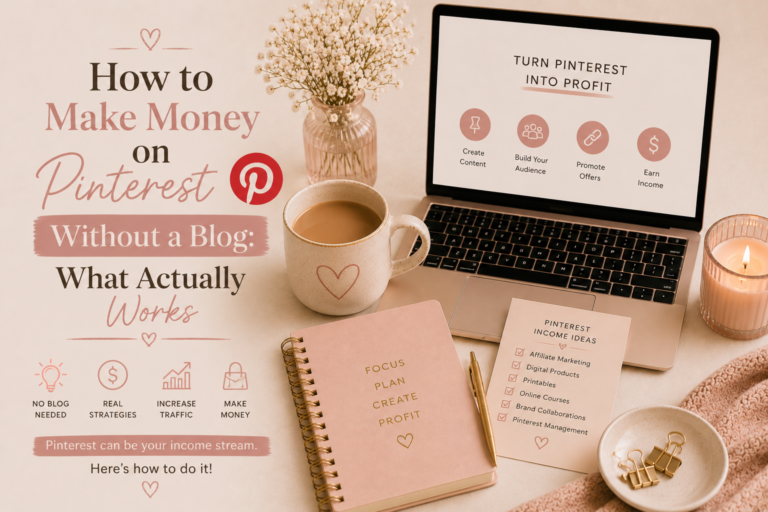
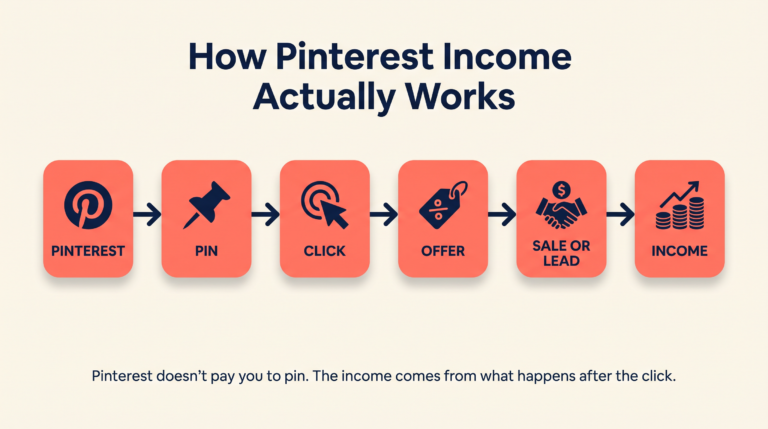
Quick Answer: Yes. You can make money on Pinterest without a blog. You can send Pinterest traffic directly to affiliate products, digital products, an Etsy shop, a service page, or an email list. Pinterest does not pay you for creating pins. The income comes from what happens after the click.
Pinterest → Pin → Click → Offer → Sale or Lead → Income
What's In This Post
ToggleThat is the entire model. No blog required.
I want to clear something up before we go any further.
Pinterest is not the income source. Pinterest is the traffic source.
Most beginners miss this distinction. They focus on followers and monthly views expecting those numbers to translate into money. They do not. Not directly.
What translates into money is what happens after someone clicks your pin. If the click goes to a relevant affiliate product, a digital product, a service, or an email opt-in, that click can become income.
If the click goes nowhere useful, it earns nothing regardless of how many people saw the pin.
Keep that distinction in mind throughout this entire guide.
7 Ways to Make Money on Pinterest Without a Blog
1. Pinterest Affiliate Marketing
This is the most accessible starting point for most beginners and the method I recommend first.
How it works:
- You join an affiliate programme for free
- You get a unique tracking link
- You create a pin that leads to a relevant product
- Someone clicks the pin and buys the product
- You earn a commission
The funnel:
Pinterest Search → Pin → Affiliate Link → Brand → Purchase → Your Commission
What makes a good affiliate pin:
- It solves a specific problem the reader already has
- The product genuinely solves that problem
- The pin title matches what someone would search for
- The destination delivers on the promise of the pin
Affiliate programme examples for Pinterest:
- Amazon Associates for physical products in almost any niche
- Travelpayouts for travel content
- ShareASale for lifestyle, home, and fashion
- Awin for fashion and European brands
- Impact for software and technology tools
What beginners get wrong:
Most beginners create pins that lead directly to a product page with no context. The conversion rate is low because the reader arrived cold with no trust established.
The better approach is to lead the pin to a genuinely useful resource, even a simple landing page or a free guide, that warms up the reader before presenting the affiliate product.
Disclosure is required.
Pinterest’s policy on affiliate content is clear. It must be original, add genuine value, and be transparent about its commercial nature. Add a clear affiliate disclosure to pins and to any landing page your pins lead to. This is both legally required in most countries and the right thing to do.
2. Sell Digital Products Through Pinterest
Create a product once. Sell it repeatedly. No inventory. No shipping.
The funnel:
Pinterest Search → Pin → Product Page → Purchase → Income
What sells well:
- Canva templates
- Budget planners and spreadsheets
- Travel planners and packing lists
- Journal and planner printables
- Checklists and workbooks
- Ebooks and guides
- Meal planners
- Fitness trackers
A real beginner example:
Niche: Budgeting for single mothers
Product: $9 monthly budget planner in Canva
Pin title: Simple Monthly Budget Template for Single Moms
Pin destination: Gumroad product page
Someone searches simple budget template for moms. They find the pin. They click through. They buy a $9 product. You earn $9 with no ongoing work after the initial creation.
Create twenty pins for that one product with different search angles. Some will rank. Some will drive consistent traffic for months.
That is how digital product passive income actually works on Pinterest.
Where to sell:
Start with Gumroad. It is free to set up and simple to manage. Add Etsy later for additional discovery traffic.
3. Send Pinterest Traffic to an Etsy Shop
Pinterest and Etsy are natural partners.
Both are visual platforms. Both are search-based. Etsy buyers are already in a purchasing mindset. A well-optimised pin pointing to a relevant Etsy listing puts the right product in front of the right buyer.
The funnel:
Pinterest Search → Pin → Etsy Listing → Purchase → Income
What works well:
- Digital downloads
- Printable planners and templates
- Canva templates
- Wall art and prints
- Wedding and event stationery
- Home decor prints
- Kids activity sheets
How many pins per product:
Create at least five pins for every Etsy listing. Different headlines. Different images. Different keyword angles. Pin them to relevant boards and let Pinterest’s algorithm test which performs best.
The Etsy listing matters too.
Your pin brings the click. Your Etsy listing closes the sale. Use clear product photos, keyword-rich titles and descriptions, and competitive pricing to convert the Pinterest traffic into purchases.
4. Sell Your Services Through Pinterest
This is the method most people overlook. And it is the fastest path to real income for a beginner with an existing skill.
The funnel:
Pinterest Search → Pin → Portfolio or Service Page → Enquiry → Client → Income
Services that translate well to Pinterest:
- Pinterest management
- Graphic design
- Virtual assistance
- Copywriting and content writing
- Social media management
- Bookkeeping
- Business coaching
- Brand strategy
- Wedding planning
- Interior design consultation
The important point:
You do not need thousands of Pinterest followers to get a client.
You need one relevant pin to reach one person with the problem your service solves. That is it. One pin. One click. One enquiry. One client.
Create pins that position you as the expert in your specific niche. Share tips, results, case studies, and process insights that demonstrate genuine knowledge. The pin that shows you know what you are doing converts a stranger into an enquiry.
5. Use Pinterest to Build an Email List
This is strategically the most important method on this list.
Here is why. Pinterest controls the distribution. You control the email list.
Pinterest can change its algorithm tomorrow. Your email list stays yours regardless of what any platform decides.
The funnel:
Pinterest Search → Pin → Free Resource → Email Subscriber → Product, Affiliate, or Service Offer → Income
Free resource examples that convert well:
- Budget spreadsheet for beginners
- Travel packing checklist by destination
- Skincare routine guide for sensitive skin
- Blogging starter checklist
- Pinterest keyword research worksheet
- Meal planning template for families
How this builds income:
The pin drives the click. The free resource captures the email. The email sequence builds the relationship. The relationship converts into affiliate sales, product purchases, or service enquiries over weeks and months.
One email subscriber from Pinterest can generate significantly more income over time than one affiliate click that does not convert immediately.
Start building your list from day one. Every subscriber not captured is a relationship that never develops.
6. Sell Pinterest Templates
Use Pinterest to sell products that help other Pinterest users.
The logic is simple. Someone searching for Pinterest pin templates on Pinterest is already on the platform. They are already motivated to create better content. You are meeting them exactly where they are with exactly what they need.
What sells:
- Canva Pinterest pin templates
- Pinterest content planners
- Pinterest keyword research worksheets
- Pinterest analytics trackers
- Pinterest strategy guides
- Pinterest board planners
Where to sell them:
Etsy for discovery. Gumroad for simplicity. Your own site for control.
Create five to ten pins for each template product using different search angles. How to create Pinterest pins. Pinterest pin templates for beginners. Canva templates for Pinterest. Each angle reaches a slightly different segment of the same audience.
7. Brand Partnerships and Sponsored Content
This is the advanced option. It is included for completeness rather than as a beginner recommendation.
Brands pay Pinterest creators to create pins featuring their products or services. The payment depends on the creator’s niche relevance, audience size, and engagement quality.
What brands look for:
- Niche relevance to their target customer
- Consistent pin quality and aesthetic
- Evidence of genuine audience engagement
- Outbound click rates that demonstrate audience trust
This becomes realistic once you have built a consistent presence in a specific niche with demonstrated reach. It is not where most beginners should start. It is where consistent creators can eventually add income on top of what is already working.
Which Method Is Best for You?
| Your Situation | Best Starting Point |
|---|---|
| Need income quickly | Services |
| Have almost no money to invest | Affiliate Marketing |
| Enjoy creating and designing | Digital Products or Templates |
| Already have an Etsy shop | Pinterest to Etsy |
| Want long-term passive income | Email List + Digital Products |
| Have a specific professional skill | Services |
| Enjoy teaching or explaining | Digital Products or Coaching |
One method. One audience. One offer. Start there.
How Pinterest Makes Money Without a Blog
The confusion most beginners have is thinking Pinterest pays them directly for views or pins.
It does not.
Pinterest is the discovery engine. Income comes from the destination.
Pinterest Search → Pin → Click → Destination → Conversion
The destination can be:
- An affiliate product page
- An Etsy listing
- A digital product sales page
- A service or portfolio page
- An email opt-in landing page
- An online shop
The click is the moment of transition between Pinterest traffic and potential income. Everything before the click is about getting the right person to the pin. Everything after the click is about converting that person into a sale, lead, or client.
Most beginners focus all their energy on the before. The after is equally important.
How to Start Making Money on Pinterest: Step by Step
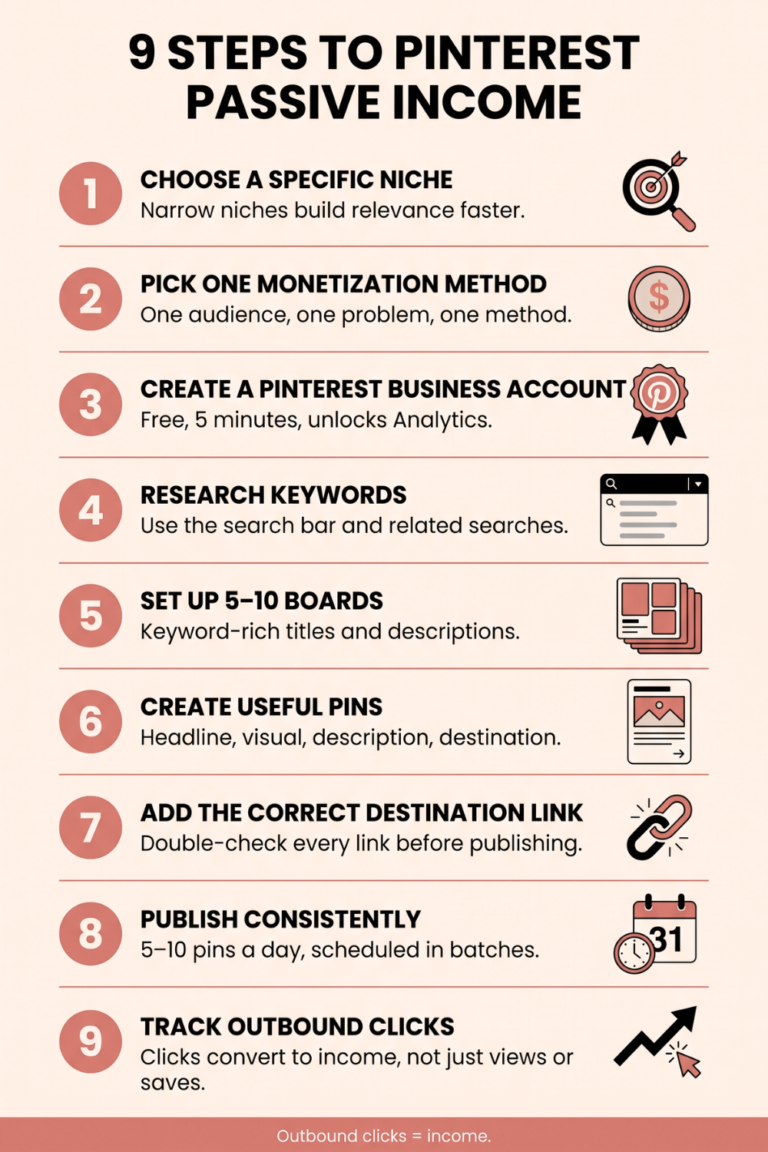
Step 1: Choose a specific niche
| Your Situation | Best Starting Point |
|---|---|
| Need income quickly | Services |
| Have almost no money to invest | Affiliate Marketing |
| Enjoy creating and designing | Digital Products or Templates |
| Already have an Etsy shop | Pinterest to Etsy |
| Want long-term passive income | Email List + Digital Products |
| Have a specific professional skill | Services |
| Enjoy teaching or explaining | Digital Products or Coaching |
The narrower the niche the faster you build relevance. The faster you build relevance the faster Pinterest distributes your content to the right people.
Step 2: Choose one monetisation method
Not affiliate marketing plus an Etsy shop plus services plus digital products.
One audience. One problem. One method. Add more once the first is working.
Step 3: Create a Pinterest business account
Free. Takes five minutes. Gives you access to Pinterest Analytics so you can track what is and is not working.
Step 4: Research Pinterest keywords
Use the Pinterest search bar. Type your niche topic and note the autocomplete suggestions. These are real searches at real volume.
Also check related searches that appear after you run a search. Each one is a potential pin topic.
Step 5: Set up relevant boards
Create five to ten boards with keyword-rich titles and descriptions. Each board should cover a specific subtopic within your niche.
Board title example: Budget Planning for Single Moms | Money Tips
Board description: Practical budgeting tips, free budget templates, and money-saving strategies for single mothers managing finances alone.
Step 6: Create useful pins
Every effective pin has four elements.
A clear headline that matches a real search query. A visual that is relevant and clean. A keyword-rich description that gives Pinterest context. A destination that delivers on what the headline promised.
Step 7: Add the correct destination
Double check every pin link before publishing. A pin sending traffic to the wrong page or a broken link wastes every impression it receives.
Step 8: Publish consistently
Five to ten pins per day is a reasonable starting point. Use Tailwind to schedule in batches rather than pinning manually every day.
Step 9: Track outbound clicks not followers
Outbound clicks tell you how many people clicked through to your destination. That is the metric that connects to income. Monthly views tell you how many people saw your pins. Saves tell you how many people bookmarked them. Outbound clicks tell you how many people acted.
Pinterest SEO: How to Get Your Pins Found
Pinterest is a search engine. Treat it like one.
Profile SEO:
Include your primary keyword in your display name and bio. HerDailySpace | Online Income, Personal Growth, Solo Travel tells Pinterest and users exactly what the account covers.
Board SEO:
Board titles and descriptions should use natural keyword language. Not My Favourite Things. Budget Planner Templates for Women and Single Moms.
Pin title SEO:
Your pin title is one of the most important keyword signals. Put the primary search term in the first five words.
| Weak | Better |
|---|---|
| My Favourite Skincare Products | 10 Affordable Skincare Products for Sensitive Skin |
| Budget Tips | How to Create a Monthly Budget on a Tight Income |
| Travel Packing | Solo Female Travel Packing List for Southeast Asia |
Pin description SEO:
Use the primary keyword in the first sentence. Include two to three related keywords naturally. Write for the reader not just the algorithm. A description that reads naturally and provides genuine context performs better than one stuffed with repeated keywords.
How Many Followers Do You Need to Make Money on Pinterest?
Far fewer than most people think.
Pinterest distributes content based on search relevance and pin quality rather than follower count. A brand new account with zero followers can create a well-optimised pin that appears in search results and drives outbound clicks within its first week.
This is the fundamental difference between Pinterest and audience-based platforms like Instagram and TikTok.
On Instagram a post with low followers reaches almost nobody. On Pinterest a pin with zero followers can rank for a search term and drive consistent traffic for months.
Followers on Pinterest indicate a loyal audience that sees your content in their home feed. They are worth building over time. They are not a prerequisite to making money.
Focus on search-optimised pins. Follower growth follows naturally.
How Much Can You Make on Pinterest Without a Blog?
Honest answer rather than an aspirational one.
Here is how the economics actually work.
Simple example:
10,000 monthly Pinterest impressions
× 2% outbound click rate = 200 clicks
× 5% conversion rate = 10 sales
× $5 average commission = $50 per month
Scale the traffic. Improve the conversion rate. Increase the commission value. The income grows proportionally.
Three levers to increase Pinterest income:
More targeted traffic from better keyword research and more consistent pinning.
Better conversion from stronger pin copy, more relevant destinations, and higher quality offers.
Higher value offers from promoting products with larger commissions or selling your own digital products.
The income potential is real. The timeline is months not days. Anyone promising specific income figures without knowing your niche, your offer, and your traffic is guessing.
Common Pinterest Money-Making Mistakes
Mistake 1: Treating Pinterest like Instagram.
Pinterest is a search engine. Stop worrying about aesthetics and start worrying about keywords.
Mistake 2: Choosing a niche that is too broad.
Lifestyle. Travel. Health. These are not niches. They are industries. Narrow down to a specific audience with a specific problem.
Mistake 3: Promoting random products.
Affiliate products that are not relevant to your niche produce low click rates and lower conversion rates. Relevance drives commission.
Mistake 4: Creating pins without keyword research.
A beautiful pin nobody searches for drives zero traffic. Keyword research before pin creation. Every time.
Mistake 5: Sending every pin to the same destination.
Different pins solve different problems. Each pin should go to the most relevant and most useful destination for that specific search query.
Mistake 6: Focusing on followers instead of clicks.
Followers are vanity. Outbound clicks are income. Track what matters.
Mistake 7: Expecting immediate passive income.
Nothing on Pinterest is passive from day one. The passive quality develops after weeks and months of consistent pinning. Build first. Compound later.
Mistake 8: Ignoring affiliate disclosure requirements.
Required by law in most countries. Non-negotiable. A simple disclosure statement on your pin or landing page is sufficient and builds rather than undermines trust.
Do You Need a Website to Make Money on Pinterest?
| Monetisation Method | Website Required? |
|---|---|
| Affiliate links | Not necessarily |
| Etsy shop | No |
| Digital products via Gumroad | No |
| Services | A simple page helps but not essential |
| Email list | A landing page helps, not a full website |
| Display advertising | Yes |
| Your own ecommerce store | Usually yes |
Short answer: No.
A website gives you more control over the destination experience, better SEO potential for long-term traffic, and more flexibility in how you monetise. But it is not required to start.
Begin without one if that is the barrier. Add one when the income from Pinterest justifies the investment.
Pinterest Affiliate Marketing Without a Blog: What You Need to Know
Because this is one of the strongest search intents around this topic, it deserves its own focused section.
Choose relevant affiliate programmes:
Join programmes whose products genuinely serve your specific audience. Relevance converts. Random recommendations do not.
Create pins around the problem not the product:
A pin titled best travel insurance for solo female travelers converts better than one titled click here for travel insurance. The first matches a real search. The second is an advertisement.
Disclose clearly:
Add affiliate disclosure to pins and to every landing page affiliate links appear on. Pinterest’s own policy requires transparency about commercial content.
Track your affiliate clicks:
Most affiliate dashboards show click data. Monitor which pins drive the most clicks to each affiliate link. Create more content around the highest-performing topics.
Avoid spam tactics:
Pinning the same affiliate link repeatedly across unrelated boards, using misleading headlines, or hiding the commercial nature of content all violate Pinterest’s policies and damage long-term account health.
The complete guide to Pinterest affiliate marketing is covered in full detail in the HerDailySpace Pinterest Affiliate Marketing guide.
FAQ
Can you make money on Pinterest without a blog?
Yes. Pinterest can send traffic directly to affiliate products, Etsy listings, digital product pages, service pages, or email opt-ins without a blog required.
Can you make money on Pinterest without a website?
Yes. Gumroad, Etsy, and affiliate product pages are all valid destinations for Pinterest traffic without requiring your own website.
How many followers do you need to make money on Pinterest?
Potentially none. Pinterest distributes content based on search relevance rather than follower count. A well-optimised pin on a new account can appear in search results and drive outbound clicks from day one.
Can I use affiliate links directly on Pinterest?
Yes. Pinterest allows affiliate links in pins provided the content is original, adds genuine value, and clearly discloses the commercial relationship.
What is the easiest way to make money on Pinterest?
Affiliate marketing is the most accessible starting point because it requires no product creation and no large existing audience. The trade-off is that the income depends on driving enough targeted traffic to convert into commissions.
Can beginners make money on Pinterest?
Yes. The search-based discovery model means a new account with no followers can drive traffic from day one with well-optimised pins. Results take consistency across weeks and months rather than days.
How much does Pinterest pay per 1,000 views?
Pinterest does not pay creators directly for views. Income comes from what happens after the click, affiliate commissions, product sales, or service enquiries, rather than from the views themselves.
Can you sell digital products on Pinterest?
Yes. Pinterest is one of the most effective platforms for driving digital product sales. Create pins that address the specific problem your product solves and link directly to the product purchase page.
Can you make money on Pinterest with no money?
Yes. A Pinterest business account is free. Many affiliate programmes are free to join. Free tools like Canva have sufficient functionality for creating effective pins. The investment is time rather than money.
How long does it take to make money on Pinterest?
Most beginners see first meaningful results within two to six months of consistent, keyword-focused pinning. The timeline depends on niche competition, pin quality, posting consistency, and how well the destination converts clicks into income.
Your 30-Day Pinterest Money-Making Plan
Week 1: Choose and Set Up
- Choose your specific niche
- Choose one monetisation method
- Create a Pinterest business account
- Research thirty keywords using Pinterest search suggestions
- Create five keyword-optimised boards
Week 2: Create and Publish
- Create ten to fifteen pins around your top keywords
- Set up your offer destination, product page, affiliate link, or email opt-in
- Optimise your Pinterest profile with keyword-rich bio
- Start publishing five pins per day
Week 3: Test and Improve
- Create more pins around the search terms showing early impressions
- Test different headline approaches for the same topic
- Monitor outbound clicks in Pinterest Analytics
- Identify which topics drive the most clicks
Week 4: Double Down and Expand
- Create more content around the highest-performing topics
- Improve the offer or destination page based on conversion data
- Begin building an email list if not already started
- Plan the next thirty days based on what worked in the first thirty
The goal of month one is not to build a Pinterest empire.
The goal is to build a repeatable system that you can run consistently for the next six months. The income comes from the six months not from the first thirty days.
Start With One Simple Pinterest Funnel
One niche.
One audience with one specific problem.
One offer that solves that problem.
Pinterest pins that connect the search to the offer.
Clicks that become sales, leads, or clients.
That is the entire system.
You do not need a blog to build it. You do not need thousands of followers to start. You need one relevant offer, one targeted keyword strategy, and the consistency to keep pinning long enough for the compounding to begin.
Not Sure Which Online Income Path Is Actually Right for You?
Pinterest is one of several paths available to someone building online income from scratch.
It is not the right starting point for everyone. But for someone with a specific niche, a relevant offer, and the patience to build a keyword-driven content system, it is one of the most accessible entry points to passive income that exists.
If you are still figuring out whether Pinterest, affiliate marketing, a blog, or a completely different model makes the most sense for your specific situation, the Crossroads Blueprint was built for exactly that decision.
Explore the Crossroads Blueprint →
With love,
Nia